It’s been too long since we last visited Anne Rodman’s 1939 beauty advice book, “Lady, Be Lovely”. I decided to turn the page today and see what my favorite beauty authority would have in store. I was delighted to find information on how to have beautiful bosoms, back, and shoulders.
Anne makes a case for plastic surgery for a woman’s breasts but only if, as she states, it is absolutely necessary. Her preference is for an uplifting brassiere. Things don’t appear to have changed much since the publication of “Lady, Be Lovely” — women are still pursuing pefect breasts. I believe that Anne would approve of Dita Von Teese’s choice of underpinnings and, like the rest of us, be envious of her incredible form.
Dita Von Teese in a Wonderbra
And what about the “…youthful contour, after the manner of the Balinese maidens” Anne mentioned? Below are “Two Balinese Maidens” by Theo Meier, and I’d say that “youthful contour” is an understatement.
Two Balinese Maidens
In the 1930s a beautiful back was crucial if a woman wanted to follow the trend in evening gowns. Bette Davis looked stunning in her frock. She had the back and shoulds to make the most of it.
Bette Davis
According to Ms. Rodman, a woman could achieve a beautiful back by stretching backward over a hassock.
Now, according to a woman’s magazine, we can have a ball!
From the mid-1600s until 1854 Japan had been, by choice, a very isolated nation. They may have continued their isolation for another 200 years if it had not been for the Treaty of Kanagawa (aka Perry Convention). The treaty was signed by the Japanese under pressure from U.S. Commodore Matthew C. Perry. In 1853 he had sailed into Tokyo Bay with a fleet of warships and had demanded that the Japanese open their ports to U.S. ships for supplies. It was clear to the Japanese that the Commodore would return and make things very unpleasant for them if they didn’t capitulate. The Japanese signed similar treaties with Britain, France, and Russia.
Ad is circa 1918
As a result of these new trade agreements, Westerners became obsessed with all things Japanese. One of the things that intrigued Westerners the most were the bathing habits of the Japanese. At a time when folks in the U.S. were setting aside a few moments on a Saturday to scrub themselves clean of a week’s accumulation of grime, the Japanese were bathing daily and, rumor had it, frequently more than once each day!
The West, specifically the Caucasian West, felt that they were morally superior to nearly everyone else on the planet. How alarming it must have been for them to reflect on “Cleanliness is next to godliness” – and realize that they’d fallen way behind the Japanese in honoring that virtue.
Companies such as Pear’s in the U.K., and Kirk’s in the U.S. jumped on the cleanliness bandwagon. Instead of homemade soap used for everything from cleaning the day’s dishes to washing mom’s hair, personal bars of soap were being marketed with slogans such as “Have you used Pear’s soap today?”
The West’s fascination with Japan wasn’t confined to bathing habits, and it wasn’t an obsession of a few months duration.
Years after the treaties, on March 14, 1885, the Gilbert & Sullivan comic opera “The Mikado” opened in London. It ran at the Savoy Theater for 672 performances! Here’s a video, from the 1999 film “Topsy Turvy” a fictionalized account of the creation of the Mikado.
Many Japanese were understandably ambivalent about the Mikado; however, maybe people were too quick to assume that all Japanese would be offended. When Prince Fushimi Sadanaru made a state visit in 1907, the British government banned performances of The Mikado from London for six weeks, fearing that the play might offend him—a maneuver that backfired when the prince complained that he had hoped to see The Mikado during his stay. A Japanese journalist covering the prince’s stay attended a proscribed performance and confessed himself “deeply and pleasingly disappointed.” Expecting “real insults” to his country, he had found only “bright music and much fun.”
In 1947 General Douglas MacArthur banned a large-scale professional production of Mikado in Tokyo by an all-Japanese cast. I’m surprised that MacArthur was even aware of the proposed production; after all he was busy being in command of the occupation forces, as well as undertaking the democratization of Japan – complete with a ratified Constitution and the enfranchisement of women.
None of this meant much to Iva Ikuko Toguri D’Aquino, or as she would forever become known, Tokyo Rose.
Iva was born in Los Angeles, she was a Girl Scout, a Methodist, and she had graduated from UCLA with a degree in zoology. In other words, Iva was an all-American girl. She left for Japan in July 1941, possibly to care for an ailing relative, or to attend medical school.
Iva had been issued a Certificate of Identification, she didn’t have a passport. In September 1941 she applied to the U.S. Vice Consul in Japan for a passport, but she’d not received an answer by the December 7, 1941 attack by the Japanese on Pearl Harbor. She was stranded in Japan for the duration.
Iva was pressured by the Japanese Central Government to renounce her U.S. citizenship; she refused. She risked her life to provide POWs with food. By 1943 she, and prisoners of war, were coerced into producing radio broadcasts intended to demoralize the U.S. troops. She participated, but would not speak against the United States – and at no time did she refer to herself as Tokyo Rose. The name was a catch all used by U.S. troops to describe all of the women who made the propaganda broadcasts.
Iva was arrested at the end of the war and thoroughly investigated by the FBI. The FBI concluded that: “the evidence then known did not merit prosecution”.
Even so, in 1949 Iva was tried in San Francisco for treason. She was found guilty on one count, that on a certain date in 1944 she “did speak into a microphone concerning the loss of ships.” She was fined $10,000 and given a 10-year prison sentence. Attorney Collins called the verdict “Guilty without evidence”. She was sent to the Federal Reformatory for Women at Alderson, West Virginia. She was paroled after serving six years and two months, and released January 28, 1956.
She was granted a full and unconditional Presidential pardon by Gerald Ford on January 19, 1977, his last full day in office. She passed away on September 26, 2006; she was 90.
This is such a wonderful photo – it is of Raymond Chandler and Dorothy Fisher (nee Gruber). Dorothy worked as his secretary at Paramount Studios in the 1940s. I was fortunate to have met Dorothy, she was an honored guest on a couple of Esotouric’s Chandler tours, and she was a remarkable woman. Because we lived near each other we’d carpool to the departure location for the tour. We’d swap stories in the car on the way. She told me about a dinner date in Malibu with the actor Ray Milland, and she also told me about meeting Billy Wilder. She said that Wilder was a powerfully magnetic man: “he made you feel like you were the only person in the room” she said.
Dorothy passed away in December 2008, and I will be forever grateful for the opportunity to have spent time in her company. She was talented, intelligent, lovely, and a lady through and through. I think of her each time we visit Chandler’s Los Angeles.
So, if you’re a fan of noir, crime fiction, the Los Angeles Athletic Club and/or the best gelato in Los Angeles, this tour is for you! Because we stop at the historic Hollywood restaurant Musso & Frank, by the end of the tour I’m craving a gin gimlet something fierce. Lucky for me Scoops gelato generally offers a few liquor flavored choices (the vanilla/Jim Beam is delightful!)
I hope you’ll join us – especially since July is the month of Chandler’s birth.
I stepped out of the Vintage Powder Room for the month of June. Why? Well, I was establishing VPR on Facebook. When I am doing resarch for the posts for this blog, I frequently find some terrific tidbits that don’t justify an in-depth post, but are simply too wonderful not to share.
I’ve found that Facebook is perfect for the shorter posts, as is Twitter. So, if you have only a few moments to spare for the Vintage Powder Room and want to see some fabulous photos, videos, or items from my collection, look for me on Twitter (vtgpowderroom), or on Facebook (search for Vintage Powder Room). You’ll find links for both by scrolling down this page.
Now it’s time for me to roll up my sleeves and get back to work.
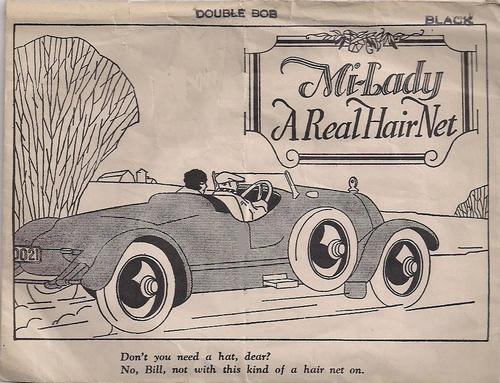
As soon as I saw the roadster (a Duesenberg?) in the illustration on the hair net package, I knew that the jaunty young lady at the wheel had to be the world renowned girl detective Nancy Drew.
When you were a child did you ever want to be Nancy Drew? I did. And all these years later I’m still so captivated by the idea of being a gal gumshoe, a dame detective, a she shamus, that I give crime tours with the LA-based company Esotouric on most weekends. But even the tours aren’t enough to satisfy my longing be a PI, cop, or a stylish and witty helpmate, like Myrna Loy in the Thin Man films.
Just because I never became a private investigator or cop (I like to believe that I DID become a stylish and witty helpmate) that doesn’t mean that I can’t pursue my crime busting dreams. I’ve discovered a few ways in which to get my crime fix – the aforementioned tours, and I volunteer at the Los Angeles Police Historical Society (LAPHS).
Diana Rigg as Mrs. Peel
The historical society has a fantastic museum which is housed in an old police station. I spend my time there organizing and digitizing a collection of Daily Bulletins, and Juvenile Reports. The Bulletins began in 1907 and were distributed to each officer, every day (with the exception of Sundays and holidays). The Bulletins provide a daily snapshot of life in the growing city of Los Angeles, as reflected in the criminal behavior of its citizens.
Nancy Drew did her sleuthing in River Heights, not in Los Angeles, and she began her amateur detecting as a 16 year old in 1930. The early books depict Nancy as a very modern girl — just as she should have been in the years following WWI. She had a litany of accomplishments including: dancer, driver, cook, car mechanic, swimmer, seamstress, painter — and she was fluent in French! If she’d had a leather cat suit, I’m sure she could have given Mrs. Emma Peel (of the 1960s series The Avengers) a run for her money.
Mildred in mid-dive c. 1925
The woman who ghosted the Nancy Drew books for the Stratemeyer Syndicate from 1929 to 1953 was Iowan, Mildred Wirt Benson. Mildred was nearly as accomplished as Nancy. At the University of Iowa she participated in swimming, soccer, and was a student journalist. Following graduation she worked as a general reporter for the The Clinton (Iowa) Herald.
Mildred was only 21 when, in 1926, she answered an ad placed by the Stratemeyer Syndicate for ghost writers. Her first assignment resulted in the novel, Ruth Fielding and Her Great Scenario.
Mildred appears to have remained as feisty as Nancy Drew ever was, because she began to take flying lessons at age 59. I’m glad to report that Mildred lived a long life – she passed away in 2002 at the age of 96.
Nancy Drew has gone on to have a long and eventful life too. There were some terrific films in the 1940s featuring Bonita Granville as Nancy, and more recently (2007) Emma Roberts played the girl sleuth. In 2002 the first Nancy Drew book, The Mystery of the Old Clock, sold over 150,000 copies!
Oh, and if you think that Nancy Drew was a pre-feminist bimbo who couldn’t possibly have had an impact on intelligent and strong women, think again. Secretary of State, Hillary Rodham Clinton cites her as an early influence, and so do Supreme Court Justices Sandra Day O’Connor, Ruth Bader Ginsberg, and Sonia Sotomayor.
Vintage cardboard face powder boxes simply don’t lend themselves to travel – which was a huge dilemma (and source of irritation) for me until I began this blog. Every collector wants to be able to show off what they’ve found, and I’m no different. I thoroughly enjoy having this forum to shine a spotlight on the fantastic boxes, hair pin cards, advertising, etc., that I’ve amassed over the years.
I’m careful to photograph each item as well as I can to try to capture their fragile beauty, but the photos are no substitute for seeing them in person. Only in person can you get the feel for them as having belonged to someone — having graced a woman’s dressing table. I never get over the fact that these items were packaging, designed to catch a woman’s eye, but ultimately meant to be discarded. I’m grateful to the women who, over the decades, kept the boxes safe from harm in dresser drawers, or in sewing rooms (the empty boxes often became a place to store buttons or other small sewing necessities).
I consider myself to be both a social historian and a cultural archaeologist. This definition I found for archaeology says it best: “the study of the past through material remains.” The powder boxes, rouge tins, and other cosmetics artifacts I collect tell the story of women in the context of different periods of time (my earliest items are over 100 years old).
This coming Sunday I’ll have an opportunity to put a few of my items on display when I host a curated conversation about vintage cosmetics ephemera and the history of cosmetics at Clifton’s Cafeteria in downtown Los Angeles. My presentation will be part of a special program at the May 30th LAVA (Los Angeles Visionaries Association) Sunday Salon (http://lavatransforms.org/salon510).
I’ve entitled my presentation “Pandora’s Boxes”, and I hope you’ll join me (the link above provides all of the details). Where else but LA could you satisfy your craving for confetti Jello, AND see a great display of vintage cosmetics items?
Photograph is courtesy of the Los Angeles Public Library.
The 1920s and 1930s found women experimenting with make-up as never before. School administrators were scandalized as their female students and teachers appeared in class in the latest fashions with their knees exposed, hair smartly bobbed, eyebrows and eyelashes tinted an inky black. Preachers raged from their pulpits that “powder and paint” were condemning a generation of women to eternal damnation. The preachers may have been right in a way that they could never have predicted.
In those early years there was nothing to prohibit unscrupulous manufacturers from whipping up toxic potions that would turn a tidy profit. The manufacturers worried only about their bottom line, and not about the contents of the poisonous cosmetics which could result in blindness, disfigurement or even death.
On the road with Eleanor Roosevelt
In 1933 Consumer’s Research was trying to gain support for a federal law that would establish and enforce standards for everything from malted milk to cosmetics. An exhibit was created to demonstrate to Congress the need for legislation to proctect consumers – but it ended up going on the road with none other than First Lady Eleanor Roosevelt. A reporter dubbed the exhibit the “Chamber of Horrors” and the name stuck.
Here in Los Angeles there was a popular eyelash dye which was available in salons under the name of Louise Norris. Despite the fact that the product had long been suspected of being dangerously toxic, it remained on the market for years. In 1940 the Los Angeles Times reported that 44 year old Louise Norris had been busted by state health authorities for distributing poisonous eyebrow and eyelash dye through her cosmetics company.
From the Chamber of Horrors exhibit
The most horrifying case of damage done by a commercial dye was that of “Mrs. Brown.” In 1933, the lovely pseudonymous socialite had attempted to enhance her beauty by applying Lash Lure. It took three excruciating months for Lash Lure to destroy Mrs. Brown’s corneas, causing her to become permanently blind. What she hadn’t known was that the primary ingredient of Lash Lure and similar products was aniline dye.
Aniline is a highly toxic substance, more appropriate for tinting leather than coloring human hair. It is extremely dangerous if inhaled or absorbed through the skin. And before you get too smug, you should note that aniline is not a relic of the Deco era. It is currently used in polyurethane to manufacture rigid foam, in sealants… and condoms.
According to Anne Rodman, no matter what your figure you MUST exercise. I couldn’t agree more. In fact tomorrow morning I’ll be at the gym for a spinning class, followed by Pilates.
If I’m not symmetrical, it’s not for lack of trying.
Most of the celebrities who have appeared on “Dancing with the Stars” have said that they’ve lost weight. Anne Rodman, author of “Lady, Be Lovely”, knew as much in 1939.
Here’s what she had to say about dancing your way to beauty.