« Previous PageNext Page »

Vintage cardboard face powder boxes simply don’t lend themselves to travel – which was a huge dilemma (and source of irritation) for me until I began this blog. Every collector wants to be able to show off what they’ve found, and I’m no different. I thoroughly enjoy having this forum to shine a spotlight on the fantastic boxes, hair pin cards, advertising, etc., that I’ve amassed over the years.
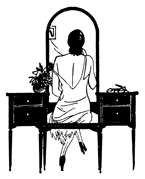
I’m careful to photograph each item as well as I can to try to capture their fragile beauty, but the photos are no substitute for seeing them in person. Only in person can you get the feel for them as having belonged to someone — having graced a woman’s dressing table. I never get over the fact that these items were packaging, designed to catch a woman’s eye, but ultimately meant to be discarded. I’m grateful to the women who, over the decades, kept the boxes safe from harm in dresser drawers, or in sewing rooms (the empty boxes often became a place to store buttons or other small sewing necessities).

I consider myself to be both a social historian and a cultural archaeologist. This definition I found for archaeology says it best: “the study of the past through material remains.” The powder boxes, rouge tins, and other cosmetics artifacts I collect tell the story of women in the context of different periods of time (my earliest items are over 100 years old).

This coming Sunday I’ll have an opportunity to put a few of my items on display when I host a curated conversation about vintage cosmetics ephemera and the history of cosmetics at Clifton’s Cafeteria in downtown Los Angeles. My presentation will be part of a special program at the May 30th LAVA (Los Angeles Visionaries Association) Sunday Salon (http://lavatransforms.org/salon510).

I’ve entitled my presentation “Pandora’s Boxes”, and I hope you’ll join me (the link above provides all of the details). Where else but LA could you satisfy your craving for confetti Jello, AND see a great display of vintage cosmetics items?


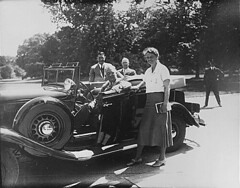
Photograph is courtesy of the Los Angeles Public Library.
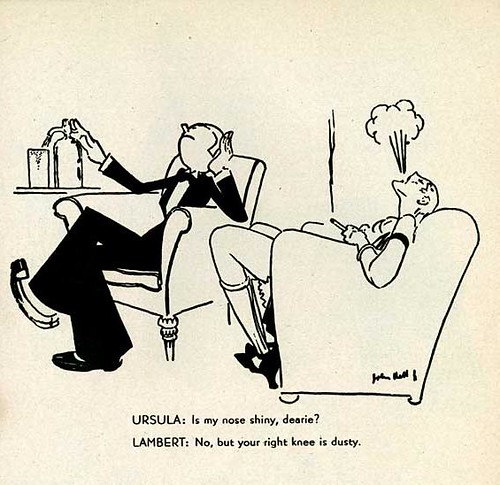
1920s obsessions: drinking, smoking, cosmetics

The 1920s and 1930s found women experimenting with make-up as never before. School administrators were scandalized as their female students and teachers appeared in class in the latest fashions with their knees exposed, hair smartly bobbed, eyebrows and eyelashes tinted an inky black. Preachers raged from their pulpits that “powder and paint” were condemning a generation of women to eternal damnation. The preachers may have been right in a way that they could never have predicted.

In those early years there was nothing to prohibit unscrupulous manufacturers from whipping up toxic potions that would turn a tidy profit. The manufacturers worried only about their bottom line, and not about the contents of the poisonous cosmetics which could result in blindness, disfigurement or even death.

On the road with Eleanor Roosevelt

In 1933 Consumer’s Research was trying to gain support for a federal law that would establish and enforce standards for everything from malted milk to cosmetics.  An exhibit was created to demonstrate to Congress the need for legislation to proctect consumers – but it ended up going on the road with none other than First Lady Eleanor Roosevelt.  A reporter dubbed the exhibit the “Chamber of Horrors” and the name stuck.

Here in Los Angeles there was a popular eyelash dye which was available in salons under the name of Louise Norris.  Despite the fact that the product had long been suspected of being dangerously toxic, it remained on the market for years.  In 1940 the Los Angeles Times reported that 44 year old Louise Norris had been busted by state health authorities for distributing poisonous eyebrow and eyelash dye through her cosmetics company.

From the Chamber of Horrors exhibit


The most horrifying case of damage done by a commercial dye was that of “Mrs. Brown.” In 1933, the lovely pseudonymous socialite had attempted to enhance her beauty by applying Lash Lure. It took three excruciating months for Lash Lure to destroy Mrs. Brown’s corneas, causing her to become permanently blind.  What she hadn’t known was that the primary ingredient of Lash Lure and similar products was aniline dye.


Aniline is a highly toxic substance, more appropriate for tinting leather than coloring human hair. It is extremely dangerous if inhaled or absorbed through the skin. And before you get too smug, you should note that aniline is not a relic of the Deco era. It is currently used in polyurethane to manufacture rigid foam, in sealants… and condoms.


Men, be afraid. Be very afraid.

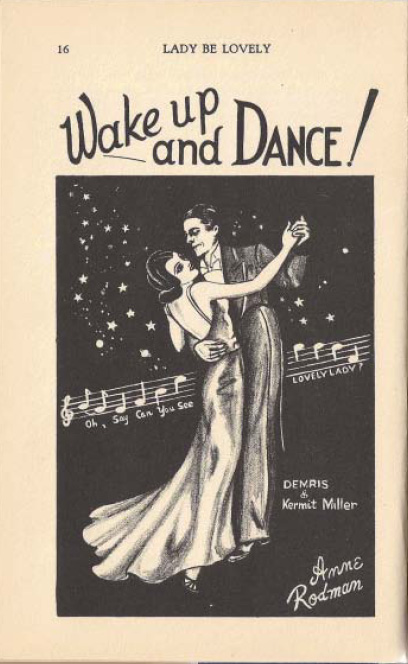
According to Anne Rodman, no matter what your figure you MUST exercise. I couldn’t agree more. In fact tomorrow morning I’ll be at the gym for a spinning class, followed by Pilates.

If I’m not symmetrical, it’s not for lack of trying.

Health spas and liquid diets aren’t new phenomenons, so it isn’t surprising that Anne Rodman would spend a few paragraphs on them.

I think a few days at a Milk Farm are exactly what I need.

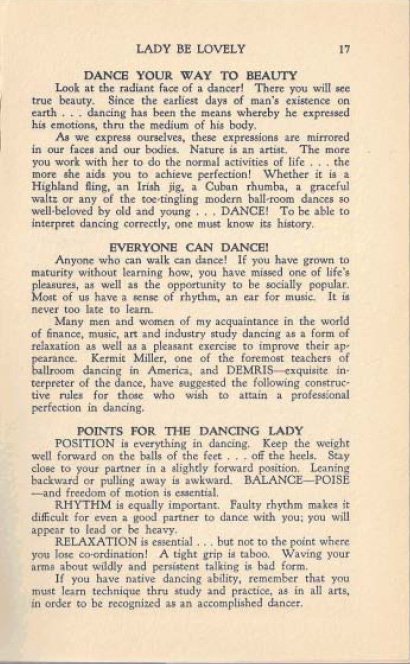
Most of the celebrities who have appeared on “Dancing with the Stars” have said that they’ve lost weight. Anne Rodman, author of “Lady, Be Lovely”, knew as much in 1939.

Here’s what she had to say about dancing your way to beauty.

So, ladies, get up off of the sofa and shake it!

I’ve been on a lipstick kick for days now. The wicked little cosmetic can end a marriage. A tube of lipstick can bring about the meeting of two people who ultimately commit murder (as in the classic film noir “The Postman Always Rings Twice”).

With lipstick so much on my mind, how could I have forgotten this gem of a song performed in 1959 by Connie Francis?

Lipstick on your collar – gonna tell on you.


Lipstick is a wonderfully versatile cosmetic.  For many women it is the one beauty item they’d take with them if stranded on a desert island. I know that it would be my choice.

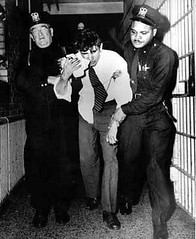
William Heirens

But, as we’ve seen over the past couple of posts, lipstick can be a trouble maker. It casts a spell on some men which lures them into liaisons with women other than their wives. It leaves tell-tale traces on clothing and skin, and lingers provocatively on cigarettes smoldering in an ashtray, or imprinted on a cocktail glass — so much power in such a little tube.  Is it possible that lipstick may drive men’s passions with a force so great that it may culminate in murder?

Take the 1946 case of William Heirens. It was alleged that between June 1945 and January 1946 the 17 year old had murdered two women, and murdered and dismembered a little girl. At the scene of the second murder, that of Frances Brown a former U.S. Navy WAV, there was message  from the killer scrawled in the victim’s lipstick. 

The Chicago press dubbed the fiend “The Lipstick Killer”, and residents of the city spent several nerve jangling months until William Heirens was arrested and they breathed a collective sigh of relief.

But did Heirens commit the murders, or was the teenager coerced into confessing by hard nosed Chicago cops desperate to make an arrest?

Sixty-four years later Bill Heirens is still alive, and still in prison.  At 81 years of age he is considered to be the longest serving prisoner in Illinois state history, and it seems that he may die there.  Death in an Illinois prison would be justice if he is guilty, but if he is innocent…

There have been many other crimes in which lipstick was used to scrawl a message on a nearby surface, or even on the body of the victim.  It doesn’t matter what words are used, or if the message consists only of cryptic symbols – there is something about the act of using lipstick that makes a compelling and strangely intimate statement.

My favorite lipstick as a portent of evil  moment comes in a scene from the 1946 film noir “The Postman Always Rings Twice” .  Frank (John Garfield) has just arrived at a small cafe. He’s a drifter and is considering responding to the “Man Wanted” sign outside when he’s greeted by the cafe’s owner, Nick (Cecil Kellaway), and urged to come in for a burger. Nick tosses a burger on the grill behind the counter, but is called away for a minute to pump gas at the station outside.
As Frank waits at the counter he hears something drop to the floor, and observes a tube of lipstick rolling toward him. As he stoops to pick it up he notices white open-toed pumps at the ends of two extremely shapely legs.  The dame wearing the pumps is also wearing white shorts, a white cropped top, and is a blonde. The blonde  is holding a compact and powdering her nose.  Frank has just met Nick’s young wife Cora (Lana Turner).  The tension between the two  is palpable.  Their eyes meet and they immediately engage in a power play.  It’s obvious from Cora’s demeanor that she is a woman who is accustomed to getting the attention of men, and having them do her bidding. She waits for Frank to bring her lipstick to her, but he doesn’t budge. Which of them will acquiesce to the other?

As you’ve seen, Cora finally gives in.  But that’s just in the short run – in the long run the breathtaking blonde convinces the drifter to commit murder. It is a perfect noir moment, made all the better in my book because a tube of lipstick is the catalyst.

A  lipstick tube introduced Frank and Cora, and it comes full circle with Cora’s death – just as Cora is promising Frank that they’ll share many kisses that “come from life”.

Ladies, when you apply your lipstick the next time  you may wish to pause and to reflect upon the power implicit in such a simple act.

I admit it – I’ve become obsessed over the past few days with the part that lipstick has played in divorce court.

A casual search of the historic Los Angeles Times unearthed about a dozen cases of divorce in which lipstick had a role.  I’ve covered two of them already this week. What I can’t figure out is if the men who came home to their wives smelling like a distillery and smeared with lipstick were simply clueless or if they wanted to be caught.
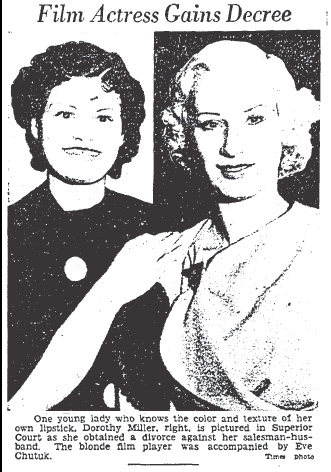
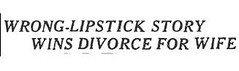
In 1935, the Le Roy Millers were a young couple married only eight months. Le Roy was a salesman who, according to his actress wife Dorothy, stayed out all night at least three times each week. 

Le Roy would come home with a lipstick stained collar and then clam up. He would refuse to divulge his whereabouts during the missing hours, and he became downright surly whenever Dorothy quizzed him.  Dorothy couldn’t rid herself of the lurid mind picture of Le Roy and some unknown cutie getting up close and personal.

Dorothy finally became so fed up with her husband’s antics that she headed for divorce court. She was accompanied by her friend, Eve Chutuk, who corroborated her testimony. 

Dorothy was granted a divorce.


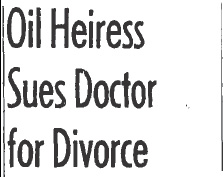
 In 1955  Antoinette B. Grant, 29, a Dutch oil heiress filed suit against her psychiatrist husband Dr. Henry J. Grant, 42.  Mrs. Grant observed that she couldn’t believe that all of the lipstick marks on his clothing had come from grateful patients. She went on to say that ever since she’d started to voice her suspicions of Henry’s infidelity he had started accusing her of being mentally unstable.

Personally, I think that Henry must have been a fan of the 1944 film “Gaslight”.  In that movie Gregory (Charles Boyer) attempted to drive his wife Paula (Ingrid Bergman) mad. It didn’t work in the movie, and it wouldn’t work for Dr. Grant either.

In a vote of no confidence Antoinette consulted another psychiatrist who told her that she was fine, except for the stress caused by her failing marriage.

By September of 1955 the Grant’s divorce proceedings had heated up. Antoinette testified that her husband frequently called her a psychopath. According to Antoinette many of the couple’s quarrels were over money. Even though their combined incomes were more than $1000 a month, Henry permitted her a weekly allowance of only $70. With that measly sum she was supposed to run the household, including the wages of a twice-a-week maid.

Henry responded to his wife’s pleas for more money by calling her irresponsible and then beating her. When Antoinette couldn’t, or wouldn’t, iron one of Henry’s shirts on demand he crushed a lit cigarette out on her neck. 

Hmm.  Sounds to me like Henry was the crazy one in the family. Physician, heal thyself!

Ultimately, Antoinette walked away with the house in Bel Air, a car, $70 a month in child support, and retained a trust fund which would pay her $6,000 per year.

As far as I’m concerned, Henry did much better than he deserved to – he got $16,000 in cash and a car.

Another marriage destroyed by that evil home wrecker, liptstick!


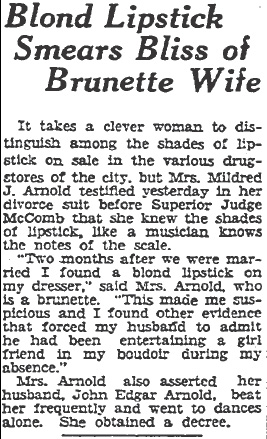
In the previous story from 1930, Mrs. Mildred J. Arnold discovered her husband’s infidelity by recognizing that a lipstick on her dressing table wasn’t her shade.

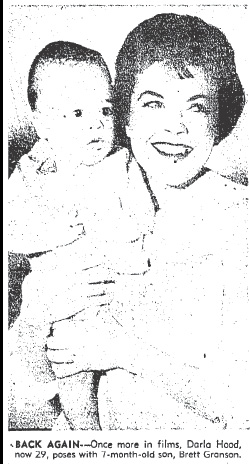
Twenty-seven years later lipstick traces were again the cause of a divorce. This time the woman was twenty-five year old Darla Hood (of “Our Gang” fame). 

If you’ve never seen any of the Our Gang shorts, shame on you — they are wonderful.  Darla played the neighborhood femme fatale (at four years old!). Here’s Darla stealing the hearts of the local boys. Who can blame them for being smitten. She’s adorable!

During the divorce hearing Darla revealed that her husband, thirty-threee year old insurance salesman Robert W. Decker, would often arrive home in the wee hours of the morning drunk and with lipstick smeared on his clothing.

Darla told Superior Judge Frederick F. Houser that one morning she “…got up and found him in the kitchen washing his shirt.” According to Robert he was trying to remove some red ink that he’d spilled on himself. Darla didn’t buy a word of his lame tale, and told him that  she was sick and tired of spending her evenings at home alone.  Robert’s response to Darla was that whatever he was doing was none of her business, then he shoved her to the floor.

The final showdown between the couple came after Robert had stayed out all night and Darla was unable to reach him by telephone. She was on a trip to San Francisco to promote one of her records, and she  and was frantic when she couldn’t locate her missing spouse. Darla testified that when she finally caught up with him,  “he asked me if I wanted a divorce, and I said I did. He said swell, go get it.”

Darla let Judge Houser know that she didn’t want any alimony. She explained that she was accustomed to taking care of herself — all she wanted was to be out of the marriage. Her decree was granted.

Oh, and the name of the song she was promoting — “Just Wanna Be Free”.


Ladies, if you think your man is cheating on you forget the GPS, and don’t hire a private investigator — check his clothes for lipstick smears. If the color on his shirt doesn’t match anything in your cosmetics case, you’ve got a problem. For instance, one of my favorite shades of lipstick is Twig by MAC. If my husband came home with traces of a screaming red lipstick on his collar he’d better be prepared with a darned good story.

Mrs. Mildred J. Arnold’s husband was tacky enough to entertain his blonde on the side in his wife’s very own boudoir! No wonder she was peeved.  Add his infidelity to the occasional beatings he administered to Mildred, and the fact that he frequently went to dances on his own and it’s no wonder Mrs. A. sued for a divorce.

 March 7, 1930

« Previous PageNext Page »