« Previous PageNext Page »

 carmen_harinet_final

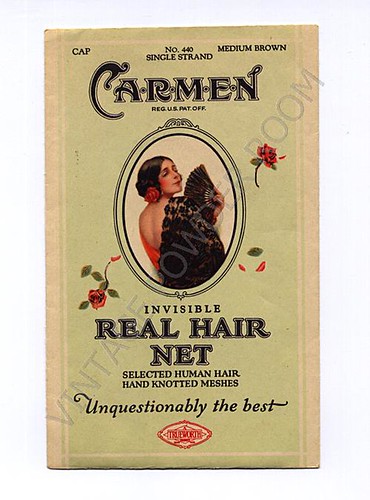
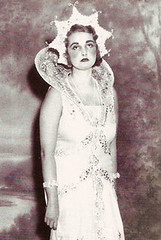
Could the woman on the hairnet envelope be anyone other than Carmen, the fiery temptress and faithless lover in Georges Bizet’s opera?Georges_Bizet_-_Rosabel_Morrison
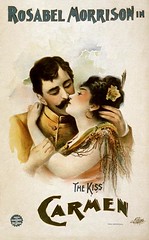
In the first act Carmen, a cigarette factory worker, seduces a young solider by tossing a flower at his feet. Really? Clearly it didn’t take too much to capture Don Jose’s attention, or his love.

By the end of the last act Carmen had dragged Don Jose’s reputation, and his heart, through the mud. Of course a woman of Carmen’s volatile temperament could not hitch her wagon to a doormat, so she would jilt Don Jose in favor of Escamillo, a handsome toreador.
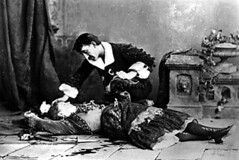
carmen death sceneIn classic operatic tradition Don Jose doesn’t thank Carmen for the memories and bid her adieu – he picks up a knife and stabs her to death just as Escamillo wins the bullfight. Opera has never been known for its subtle symbolism. And that is precisely why I enjoy opera so much. It never makes a small gesture.

There is something else that has never made a small gesture – platform shoes. They are incapable of restraint.Kiss1
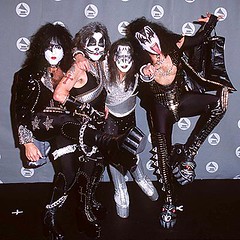
Apart from rock stars of the 1970s, my favorite wearer of platform shoes would have to be Carmen Miranda. It’s easy to think of her as an opera on two legs. And she did not earn the moniker “Brazilian Bombshell” by being a wallflower. She was bold and brash and so was her footwear.
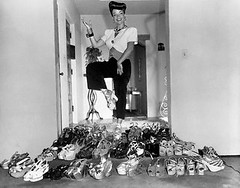
carmen miranda and shoesCarmen was born in Varzea da Ovelha, a village in the northern Portuguese municipality of Marco de Canaveses. She was christened Carmen by her father because of his love for Bizet’s masterpiece. His passion for opera influenced all of his children, and especially contributed to Miranda’s love for singing and dancing at an early age.

Her father may have been a fan of opera, but he did not approve of her plans to enter show business. However, in true operatic fashion her mother supported her and was beaten when her husband discovered Carmen had auditioned for a radio show.carmen striped shoes
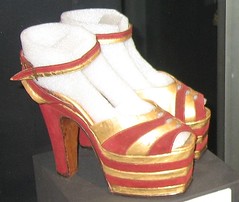
Carmen had previously sung at parties and festivals in Rio. Her older sister Olinda contracted tuberculosis and was sent to Portugal for treatment. Miranda went to work in a tie shop at age 14 to help pay her sister’s medical bills. She next worked in a boutique, where she learned to make hats and opened her own hat business which became profitable. She may never have envisioned just how well the hat making skills would pay off!
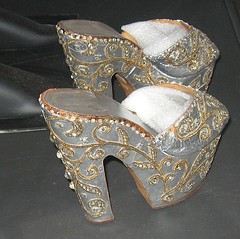
carmen miranda beaded shoes from her museumCarmen was very popular in Brazil, but once in the U.S., Carmen’s career (and platforms)  hit the ground running. She arrived in 1939 with her band, Bando da Lua. She was presented to Franklin D. Roosevelt at a White House banquet, and went on to star in a baker’s dozen of Hollywood films!

Just eight years later Carmen was the highest-paid entertainer and top female taxpayer in the U.S., earning more than $200,000!

On March 17, 1947 she married movie producer David Sebastian. He was not a successful producer and even more of a disaster when he declared himself Carmen’s manager. In the few months that they lived together as husband and wife he made a series of bad business decisions. He was a boozer, and dragged Carmen along with him. Carmen was a Catholic and would not seek a divorce so she and David were legally married until her death in 1955.

The “lady in the tutti frutti hat” has had a profound influence on popular culture, and her likeness has popped up in everything from cartoons to the character of Chiquita Banana.

On August 4, 1955 while appearing in a live segment of the Jimmy Durante Show, Carmen collapsed. She recovered quickly and resumed her performance not realizing that she’s suffered a heart attack. Her heavy smoking and alcohol consumption, compounded by her use of amphetamines and barbiturates had taken a serious toll on her health.
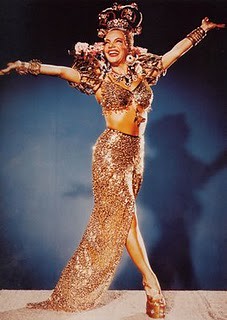
Carmen_Miranda full lengthLater that night Carmen suffered a second heart attack at her home in Beverly Hills and passed away.

Honoring her wishes, Carmen’s family had the entertainer’s body flown back to Rio de Janeiro. The Brazilian government declared a period of national mourning and 60,000 people attended a formal ceremony in Rio’s town hall. More than 500,000 people escorted the funeral cortege to her final resting place.

I’ve never had a burning desire to visit Rio de Janeiro, but after finding out that there is a Carmen Miranda Museum there – I may have changed my mind.


 debutante_1947_final

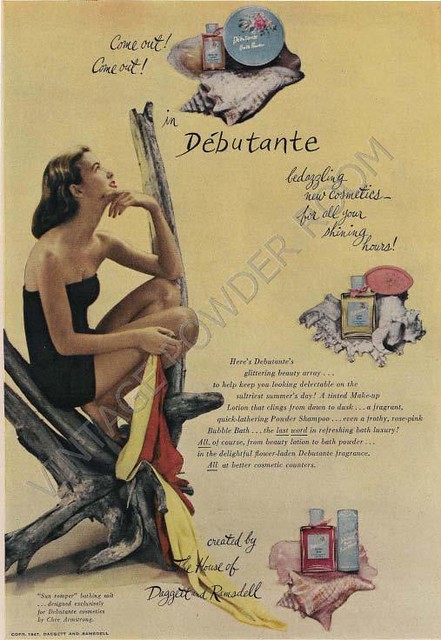
This wonderful 1947 advertisement showcases Daggett and Ramsdell’s Debutante collection of cosmetics.

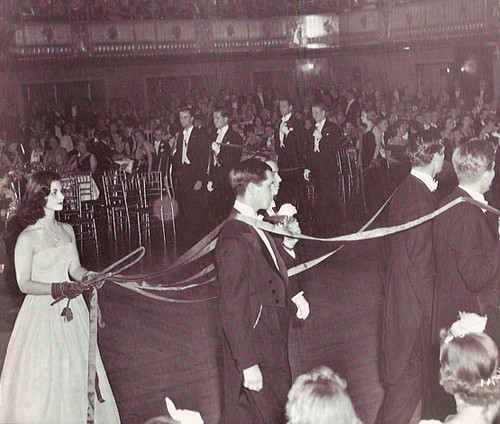
The ad calls “Come out! Come out!” which is, of course, a reference to the “coming out” parties or cotillion balls which were held to introduce a young lady (known as a debutante) from an aristocratic or upper class family to society. 

The rich are not like you and me.

The idea for the parties was to literally bring a girl out and display her to eligible bachelors and their families with an eye to marrying her off to someone within a select circle of people. An early incarnation of TV’s popular “The Bachelor”.

quinceanera-dress

Girl dressed for Quinceañero

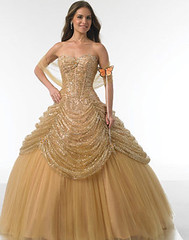
There are many versions of a coming out party in different cultures. Here in Los Angeles most of us are familiar with a Quinceañera, Quince, Quinceañero or Quince años (English: “fifteen years”) which is a Latin American coming of age ceremony for a girl marking the transition from girlhood to womanhood.

If you drive around Los Angeles on the weekends you’ll often see these ceremonies taking place. They are just as elaborate as any wedding. Planning for the Quinceañera begins at least one year in advance and involves family, friends, and a priest who will perform the ceremony in church.

debutante gown_c1890

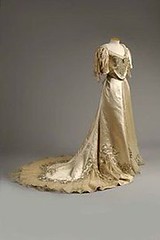
Debutante gown c. 1890s

The word debutante comes from the French débutante, and means “female beginner”. They were at their zenith during the nineteenth century; however, they exist to this day.

Personally, I’m fascinated by the American debutantes of the 1930s. The Depression era must have been a peculiar time to be a “deb”. Maybe that’s why magazines of the period focused on “poor little rich girls” like Doris Duke and Barbara Hutton.  Perhaps the fact that many of the debutantes had unhappy lives made their riches to riches stories more palatable to a woman in a bread line.

doris duke

Doris Duke

Born in New York City, Barbara Hutton was the only child of Edna Woolworth (1883–1918), who was a daughter of Frank W. Woolworth, the founder of the successful Woolworth five and dime stores. Barbara’s father was Franklyn Laws Hutton (1877–1940), a wealthy co-founder of E. F. Hutton & Company (owned by Franklyn’s brother Edward Francis Hutton), a respected New York investment banking and stock brokerage firm.

rudee valley

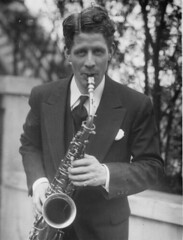
Rudy Vallee

Barbara Hutton came out on her eighteenth birthday on November 14, 1930. At the time an average ball cost around $16,000, ($208,872.81 in current dollars). Barbara Hutton’s debutante ball cost over $60,000 ($783,273.05 in current dollars). Who attended this party? The people that you would have expected to have been there, the Astor and Rockefeller families to name two. The guests were entertained by crooners Rudy Vallee and Maurice Chevalier.

barbarahutton_debutante Ritz Carlton 1931

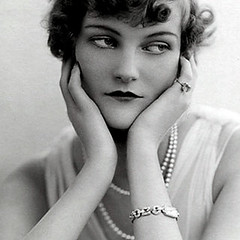
She looked so sad - Barbara Hutton c. 1931

While the average family was struggling to make ends meet during the 1930s, girls like Barbara were coming out to continue their lives of wealth and privilege. It is no surprise that public criticism was so severe that Hutton was sent on a tour of Europe to escape the scrutiny of the press and the disdain of the public at large.

By the time of Hutton’s twenty-first birthday in 1933 she had trust fund worth roughly $2 billion in today’s money. Ironically much of Hutton’s fortune came from the Woolworth five and dime stores – places she would never have to shop.woolies1930's

Actually though, there appears to have been a kernel of truth to the “poor little rich girl” moniker. Barbara’s life may have been lived in the finest clothes and spent in the most sumptuous of surroundings but, by all accounts, she was never happy. The things that money couldn’t buy continued to elude her – for example, a happy marriage. She tried marriage seven times, each ended in divorce. None of the men seemed to possess much in terms of wealth or character.

grant_hutton

"Cash & Cary"

Her first two husbands used her great wealth to their advantage, especially the extremely abusive Kurt Haugwitz-Reventlow, with whom she had her only child, a son named Lance. (Lance would die tragically at 36 in a small plane crash.) Reventlow was verbally and physically abusive. He finally beat her so savagely that she was hospitalized and he was tossed into the slammer. He had even managed to convince her to relinquish her American citizenship and to take his native Danish citizenship for tax purposes, which she did in 1937 in a New York federal court. Reventlow’s constant abuse led Barbara to drug abuse, and to anorexia (from which she would suffer intermittently throughout the rest of her life).

3brendafrazier party

Is it me, or is this a trifle kinky?

 Cary Grant, to whom she was married from 1942-1945, appears to have been the only one of her husbands who sincerely cared for her. The couple was dubbed “Cash and Cary” by the press but Grant, who had enough money and fame of his own, didn’t need anything from his wealthy wife. She would continue to describe him as the only decent man she’d ever married.

howard_hughes_women_frazier_5

Brenda Frazier

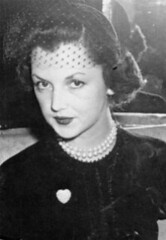
Barbara Hutton would continue to fascinate people but arguably the most famous of the 1930s debutantes was Brenda Duff Frazier.

Brenda Diana Duff Frazier’s December 1938 coming out party was so heavily publicized worldwide she eventually appeared on the cover of Life magazine for that reason alone.

Brenda’s father, Frank Duff Frazier, came from a prosperous Boston family. Her mother, the former Brenda Germaine Henshaw Williams-Taylor, was the only daughter of Sir Frederick Williams-Taylor. He was a general manager of the Bank of Montreal who was knighted in 1910 and combined his middle name and birth surname into a new hyphenated surname. A hyphenated name sounds much ritzier, don’t you think? Brenda’s parents eventually divorced, causing little Brenda to spend much time with her social-climbing maternal grandmother.

paris hilton mug shot

Paris Hilton's latest mug shot

If you thought, as I did, that the term celebutante was coined recently for the likes of Paris Hilton – well, we’re wrong! The term was created in 1939 to describe Brenda.

Brenda was greatly admired and often copied during the years when she was dubbed “Glamour Girl #1”. She anticipated Goth girls by decades when she popularized her famous “white-face” look. She used a very light colored face powder which made a stark contrast to her red lips and deep brunette hair. Fame comes at a price though – Brenda frequently suffered with a stiff neck because she was afraid to move her head, lest she displace a single hair in her perfect coiffure. Brenda also started a trend when she was photographed wearing a strapless white velvet dress. Strapless gowns quickly became a must have for women of all ages – and they remain a classic style.

brenda strapless

Like the other “poor little rich girls”, the debs of the 1930s, Brenda’s life appeared enchanted when viewed from the outside. Sadly, like her fellow debs she was also unlucky in love. She was married twice, both unions ended in divorce. And, as Barbara Hutton had done, she suffered from anorexia throughout her life.

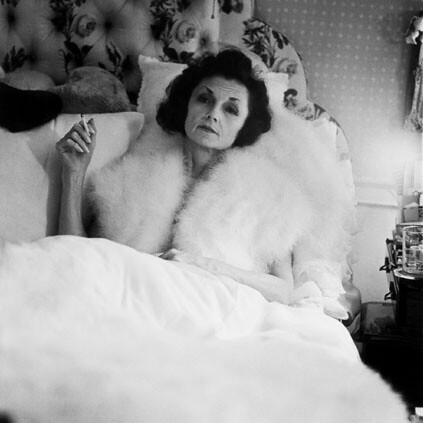
Eventually Brenda must have tired of the endless parties because she withdrew from the public eye for years. She may have slipped away unnoticed had she not been revealed at the end of her life in a photo by Diane Arbus.

If nothing else the photo serves as cautionary tale for those daughters of the fabulously wealthy who lead lives of excess without substance. 

Paris, take note.

diane-arbus-pic-of-brenda-frazier-for-esquire

Photo of Brenda Frazier by Diane Arbus


 rembha_final

aspara from cambodia

Aspara from Cambodia

This face powder box is a fairly recent addition to my collection. The name may be either an accidental or deliberate misspelling of Rambha. In Hindu mythology Rambha is the Queen of the Apsarases, who are magical and beautiful female beings in Devaloka (the plane on which gods exist). 

Rambha is accomplished in the arts of dancing, music and love-making.  When you’re a beautiful and talented woman you can bet that men are going to ask something of you.  In Rambha’s case she was frequently directed by Indra, the king of the Devas (angels) to seduce men (in particular those men practicing asceticism). The gods couldn’t risk having ascetics become more powerful than they were and one tried and true way to check a man’s devotion is to place an alluring woman within reach.  If a man could resist Rambha’s charms, then his penance was pure.

Rambha ran afoul of Rishi Vishwamitra (who was attempting to become a Brahmarishi).  Rather than merely resist the temptation presented by Rambha, Rishi cursed her and Rambha became a rock for 10,000 years!  Couldn’t he have just said no?

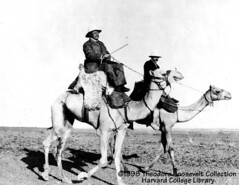
theodore roosevelt_1910_harvard college libraryThe design of the Rembha box indicates that it was made during the 1920s. It reflects the craze at the time for all things exotic, especially with an Egyptian flair. Theodore Roosevelt had travelled to Egypt in 1910, and King Tutankhamen’s tomb was discovered in 1922.  The box appears to blend the art of a few different cultures in order to achieve the overall effect. 

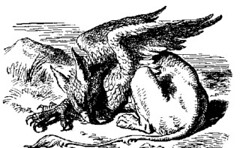
There is a hint of the Apsarases for instance, as in the photo.  There also appears to be a gryphon-like creature in the background.

The box itself is comprised of cardboard and paper which makes it all the more amazing that there is a slight bevel at the top!  It is an exquisite detail, and I would imagine this particular face powder would have been one of the pricier brands available.griffin

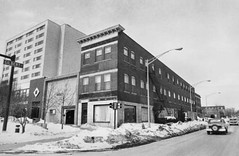
The research that I did revealed that the Boerner-Fry Company, that made the powder, was in business during the 1920s. In fact, Dr. Emil Boerner was a Prussian immigrant who built a factory in downtown Iowa City, Iowa in which he produced vanilla extract, perfumes and pharmaceuticals. 

boerner_fry_davis_hotel

Boerner-Fry Building

Dr. Boerner graduated from the Philadelphia College of Pharmacy in 1876.  That same year he returned to Iowa and opened the Boerner Pharmacy. Boerner was primarily responsible for founding the pharmacy department at the University of Iowa and in 1885 he served as the sole faculty member to 13 enrollees (twelve men and one woman).  He passed away in 1903. In 1922 the building that was his factory was converted to the Davis Hotel.

 These days the name Rehmba leads us directly to Bollywood.  Thirty-four year old Amritha is an Indian actress who uses the name Rahmba.  She’s appeared in many South Indian films and some Hindi movies.

I’d never heard of Rahmba, but when I searched for her on Youtube there were dozens of clips with views numbering well into the millions.  My world suddenly felt very small.  I am going to have to keep a closer eye on Bollywood – I’m really missing something.

the_golden_gaate_hairnet_final   

SF_chinatown gate_gift from china 1969

Grant Street, San Francisco

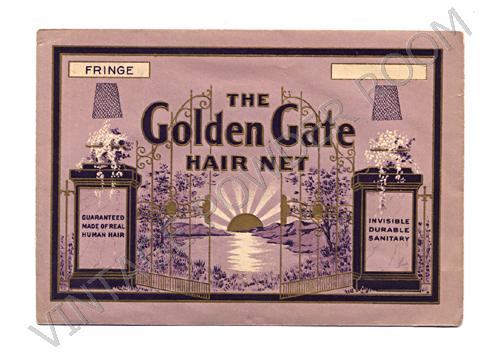
The first thing that this hair net package calls to mind is obviously the Golden Gate Bridge in San Francisco; but it actually bears some resemblance to the Grant Street Gate to that city’s Chinatown.  

My initial impulse when I sat down to write this post was to follow a straight line from the Golden Gate Bridge to Chinatown, but my thinking is rarely stays that linear.  After a few minutes I realized that what San Francisco means to me, other than 1960s psychedelic bands, is Sam Spade.  

bogart_sam spade

Humphrey Bogart

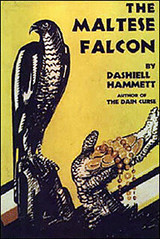
The novel THE MALTESE FALCON, featuring the character of Sam Spade, was written by Dashiell Hammett and was published in 1930 – during the Golden Age of Detective Fiction.  

The golden age of detective fiction is generally considered to be those years between the World Wars.  Many of the writers of the Golden Age were British (e.g. Agatha Christie, Dorothy Sayers); however, Raymond Chandler and Dashiell Hammett were successfully writing classic American detective stories during that period.  Today Hammett and Chandler are two of the best known of the era’s hard-boiled detective fiction authors.  

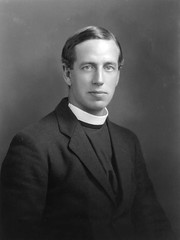
ronald knox

Ronald Knox

As early as 1929, writers were attempting to define the mystery/detective genre. Ronald Knox, an English theologian, priest and crime writer published some rules for writing detective fiction.  

According to Knox a detective story: “must have as its main interest the unraveling of a mystery; a mystery whose elements are clearly presented to the reader at an early stage in the proceedings, and whose nature is such as to arouse curiosity, a curiosity which is gratified at the end.”  

Knox’s “Ten Commandments” (or “Decalogue”) are as follows:  

  1. The criminal must be mentioned in the early part of the story, but must not be anyone whose thoughts the reader has been allowed to know.
  2. All supernatural or preternatural agencies are ruled out as a matter of course.
  3. Not more than one secret room or passage is allowable.
  4. No hitherto undiscovered poisons may be used, nor any appliance which will need a long scientific explanation at the end.
  5. No Chinaman must figure in the story.
  6. No accident must ever help the detective, nor must he ever have an unaccountable intuition which proves to be right.
  7. The detective himself must not commit the crime.
  8. The detective is bound to declare any clues which he may discover.
  9. The stupid friend of the detective, the Watson, must not conceal from the reader any thoughts which pass through his mind: his intelligence must be slightly, but very slightly, below that of the average reader.
  10. Twin brothers and doubles generally, must not appear unless we have been duly prepared for them.

the-chinese-parrot1Rule number five is particularly odious. No Chinaman? What happens when the detective is a Chinaman?  Earl Derr Biggers created Charlie Chan during the 1920s.  There are many reasons to be offended by the portrayal of Chan both in the books and in the subsequent films; however, I think  a good rule of thumb is to never apply today’s sensibilities to yesterday’s literature.  My reading list would shrink to nearly nothing if I did that.  I look at the stories in the context of their time, and by putting Charlie Chan in a position of authority I believe that Biggers was taking an interesting, and somewhat risky step forward.  

Quoting from Wikipedia: “Interpretations of Chan by critics are split, especially as relates to his ethnicity. Positive interpretations of Chan argue that he is portrayed as intelligent, benevolent, and honorable, in contrast to most depictions of Chinese at the time the character was created. Others argue that Chan, despite his good qualities, reinforces Chinese stereotypes such as poor English grammar, and is overly subservient in nature.” I’ll leave the debate on ethnicity and stereotypes to others.  

Rule number seven was probably meant to discourage other writers from doing what Agatha Christie had done so successfully in 1926, which was to write a detective novel in which the narrator turns out to be the killer.  The novel, THE MURDER OF ROGER ACKROYD, has been considered by many to have been Christie’s masterpiece.  

In 1930 Agatha Christie published her first Miss Marple novel, MURDER AT THE VICARAGE, (a classic “cozy”) and Dashiell Hammett published THE MALTESE FALCON, the only novel to feature Sam Spade and, arguably, the novel that first introduced the archetype of the hard-boiled detective to the world. In the novel Spade is cynical, bitter, and morally ambiguous, that is until he explains to Brigid O’Shaunassey his reasons for turning her in. Spade’s moral code may be non-traditional, but he adheres to it.  Spade tells her that he had fallen for her, but she had murdered his partner. He’d never be able to trust her, and he’d likely go to prison with her if he concealed what he knew from the cops.  Finally Spade tells Brigid that he’ll wait for her; provided she doesn’t hang.  


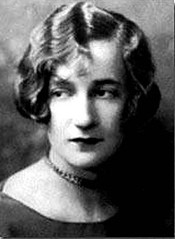
lillian hellman_young

Lillian Hellman

Hammett not only created the modern private detective, but he created two of my favorite film characters, Nick and Nora Charles.  Hammett wasn’t quite as enamored of the THIN MAN films as I am, but they did provide him with enough money to afford decent liquor, at least for a while.  Who were Nick and Nora in real life?  Hammett told his long-time companion, writer Lillian Hellman, that she was the inspiration for Nora. However, according to Hellman “Hammett said I was also the silly girl in the book and the villainess.”   

Hellman and Hammett had a 30 year long relationship – a part of which was depicted in the 1977 film JULIA starring Jane Fonda, Jason Robards, and Vanessa Redgrave.  Did Hellman really smuggle papers out of Nazi Germany in her hat as shown in the film, or had she taken another woman’s (i.e. Muriel Gardiner) story as her own?   The jury is still out on whether or not Hellman greatly embellished her autobiographies.  

In any case, JULIA was a compelling enough film to win three Oscars.  I love the movie – the costumes are exquisite, the acting superb.  It’s worth watching whether the story is Hellman’s or not. Oh, and look at this clip from the film with Meryl Streep as Anne Marie and Jane Fonda as Lillian.  

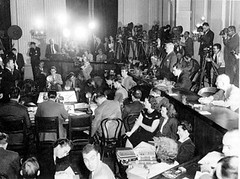
huac hearings

HUAC Hearings

During the 1950s Hammett was investigated by Congress, and testified on March 26, 1953 before the House on Un-American Activities Committee. Although he testified to his own activities, he refused to cooperate with the committee and was blacklisted.  

Others refused, as did Hammett, to cooperate with HUAC and they paid dearly.  A group of Hollywood writers who refused to cooperate with the committee became known as THE HOLLYWOOD TEN. They were Alvah Bessie, Herbert Biberman, Lester Cole, Edward Dmytryk, Ring Lardner Jr., John Howard Lawson,  Albert Maltz, Samuel Ornitz, Adrian Scott and Dalton Trumbo.  

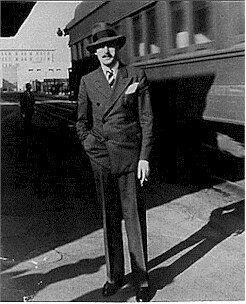
Dashiell_Hammett

Dashiell Hammett

The ten men claimed that the First Amendment of the United States Constitution gave them the right to refuse to answer questions about their beliefs. The HUAC and, subsequently, the courts disagreed and all ten men were found guilty of contempt of congress. Each of them was sentenced to between six and twelve months in prison.  

Hellman had appeared before the House Un-American Activities Committee in 1950. At the time, HUAC was well aware that Dashiell Hammett had been a Communist Party member. Asked to name names of acquaintances with communist affiliations, Hellman delivered a prepared statement which read in part: 

“To hurt innocent people whom I knew many years ago in order to save myself is, to me, inhuman and indecent and dishonorable.  I cannot and will not cut my conscience to fit this year’s fashions, even though I long ago came to the conclusion that I was not a political person and could have not comfortable place in any political group.” 

maltesefalcon

Hellman may have embellished her autobiographies, but her statement to HUAC leads me to believe that she was also a stand-up dame.    

About Hammett’s writing career, Hellman said:

“I have been asked many times over the years why he did not write another novel after The Thin Man. I do not know. I think, but I only think, I know a few of the reasons: he wanted to do a new kind of work; he was sick for many of those years and getting sicker. But he kept his work, and his plans for work, in angry privacy and even I would not have been answered if I had ever asked, and maybe because I never asked is why I was with him until the last day of his life.”   

I’ve never been able to visit San Francisco without thinking of Dashiell Hammett or Sam Spade.  Even though Hammett never wrote another novel after THE THIN MAN, his contribution to mystery fiction, in particular to the hard-boiled genre, was seminal.

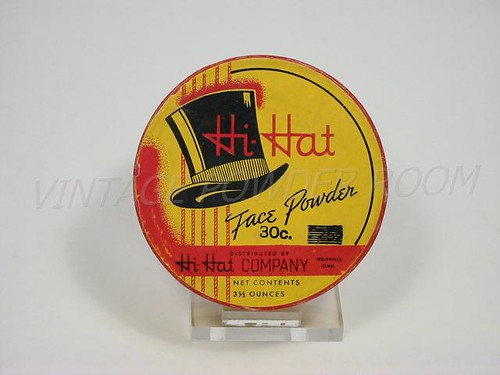
Hi-Hat_top_final
There were many companies, like Hi-Hat, that specialized in manufacturing face powder, hair treatments, and other cosmetics for African American women. 

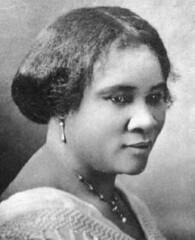
Madam C.J. Walker

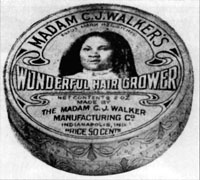
The most important and successful African American cosmetics entrepreneur was Sarah Breedlove (Madam C.J. Walker) – her story is inspiring. 

Sarah was born (one of six children) in Delta, Louisiana on December 23, 1867. Because she’d lost both of her parents by the time she was seven years old, she moved in with her older sister, Louvenia, and brother-in-law, Willie Powell.  Powell was abusive to her, so she married Moses McWilliams when she was 14 years old to escape. Three years later her daughter, Lelia McWilliams was born. When Sarah was 20, her husband died. Shortly afterward she moved to St. Louis where three of her brothers were barbers.  She may have learned some hair care tips from her brothers, but it would be her own drive and initiative that would enable her to create the company that would make her famous, and rich. 

On August 11, 1894 Sarah married a man named John Davis. That marriage ended around 1903. In January 1906 she married a newspaper sales agent, Charles Joseph Walker. They divorced in 1912.  

Walker would later say: “When we began to make $10 a day, [my ex-husband] thought that was enough, thought I ought to be satisfied.”  “But I was convinced that my hair preparation would fill a long-felt want. And when we found it impossible to agree, due to his narrowness of vision, I embarked on business for myself.”  Clearly Walker was a woman who knew what she wanted, and was unafraid of hard work. 
Her business paradigm was innovative and in the years since it has been used by other companies such as the California Perfume Company (their name was later changed to AVON).  Madam Walker knew marketing strategies of the past had focused mostly on advertising; she also knew that the majority of black women at the time were unable to read. Thus, she began a uniquely successful campaign of face to face network marketing. But what made Walker a success was not just the fact that she knew and understood her market; she was, after all, her own best customer. Walker was able to get the market on her side by using it as manpower. 

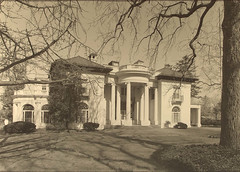
In May 1918 she moved to her Irvington-on-Hudson, New York estate, Villa Lewaro, which had been designed by Vertner Tandy, the first licensed black architect in New York State and a founding member of Alpha Phi Alpha fraternity.  

One of her neighbors was industrialist John D. Rockefeller and, it may come as no surprise that most of her stuffy, white, upper-crust neighbors had a less than welcoming attitude toward her.  “One of the race,” wrote one newspaper, “is invading the domains of New York’s aristocracy.” The New York Times even wrote, “No woman of her race could own such a place. Does she really intend to live there?”  

Madam C.J. Walker died at Villa Lewaro on Sunday, May 25, 1919 from complications of hypertension. She was only 51. At her death she was considered to be the wealthiest African-American woman in America and known to be the first Africa-American millionaire. Her daughter, A’Lelia Walker, became the president of the C.J Walker Manufacturing Company.  

I’ve been told that Madam Walker’s business model is still studied today in business schools.  I don’t know if that is true, but if it isn’t, it ought to be.   

Apart from suggesting to me the story of Madam C.J. Walker, the Hi-Hat face powder box calls to mind images of places like the famous Cotton Club, and people like the incomparable Cab Calloway. By the early 1930s Calloway’s band was the “co-house” band with Duke Ellington.  
Hi-Hat_side2_final


Calloway, who decided to pursue music rather than law as a career, was so hep that in 1944 The New Cab Calloway’s Hepsters Dictionary: Language of Jive was published.  It was an update of an earlier book in which Calloway set about translating jive for fans who might not know, for example, that “kicking the gong around” was a reference to smoking opium.  
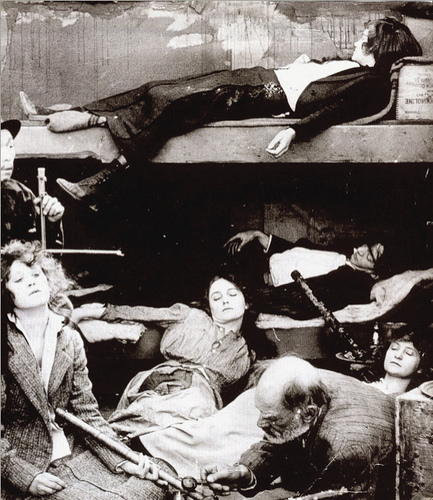
Hey, I knew that – didn’t you?  

Calloway was also a terrific scat singer.  For those of you unfamiliar with the term it is, according to Wikipedia: “… vocal improvisation with random vocals and nonsense syllables or without words at all. Scat singing gives singers the ability to sing improvised melodies and rhythms, to create the equivalent of an instrumental solo using their voice.” 

Calloway wasn’t only a first class scat sinner – he’s the father of the “moon walk”.  That’s right, if you thought that Michael Jackson invented “moon walking” – wrong.  Check out this video of Cab and Betty Boop. You’ll see the genesis of the moon walk, and hear Cab scat. 

I need a time machine. Can someone get one for me?  Right now I feel like putting on my best gown and heading over to the Cotton Club in Harlem during the 1930s.  I’ll sip a few cocktails at a front table.  And maybe I’ll get lucky and Cab and his band will be there, or even Billie Holiday or Ethel Waters.  

To finish off the evening I’ll grab a taxi to Chinatown – maybe kick a gong around.

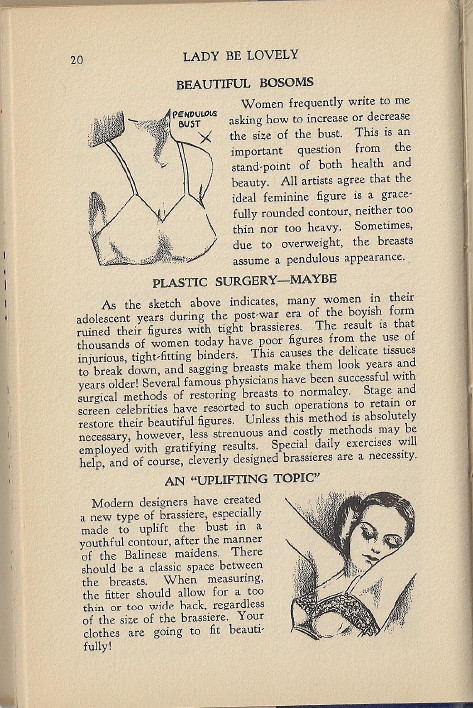
It’s been too long since we last visited Anne Rodman’s 1939 beauty advice book, “Lady, Be Lovely”.  I decided to turn the page today and see what my favorite beauty authority would have in store.  I was delighted to find information on how to have beautiful bosoms, back, and shoulders.  


Anne makes a case for plastic surgery for a woman’s breasts but only if, as she states, it is absolutely necessary.  Her preference is for an uplifting brassiere. Things don’t appear to have changed much since the publication of “Lady, Be Lovely” — women are still pursuing pefect breasts. I believe that Anne would approve of Dita Von Teese’s choice of underpinnings and, like the rest of us, be envious of her incredible form. 

Dita Von Teese in a Wonderbra


 And what about the “…youthful contour, after the manner of the Balinese maidens” Anne mentioned? Below are “Two Balinese Maidens” by Theo Meier, and I’d say that “youthful contour” is an understatement. 

Two Balinese Maidens by Theo Meier

Two Balinese Maidens


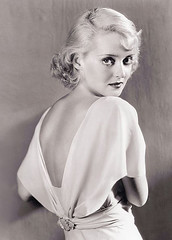
In the 1930s a beautiful back was crucial if a woman wanted to follow the trend in evening gowns.  Bette Davis looked stunning in her frock.  She had the back and shoulds to make the most of it.

Bette Davis


According to Ms. Rodman, a woman could achieve a beautiful back by stretching backward over a hassock. 


Now, according to a woman’s magazine, we can have a ball! 


I’ll see you at the gym!

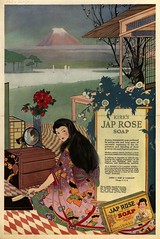
From the mid-1600s until 1854 Japan had been, by choice, a very isolated nation.  They may have continued their isolation for another 200 years if it had not been for the Treaty of Kanagawa (aka Perry Convention).  The treaty was signed by the Japanese under pressure from U.S. Commodore Matthew C. Perry.  In 1853 he had sailed into Tokyo Bay with a fleet of warships and had demanded that the Japanese open their ports to U.S. ships for supplies. It was clear to the Japanese that the Commodore would return and make things very unpleasant for them if they didn’t capitulate.  The Japanese signed similar treaties with Britain, France, and Russia.

Ad is circa 1918

As a result of these new trade agreements, Westerners became obsessed with all things Japanese. One of the things that intrigued Westerners the most were the bathing habits of the Japanese.  At a time when folks in the U.S. were setting aside a few moments on a Saturday to scrub themselves clean of a week’s accumulation of grime, the Japanese were bathing daily and, rumor had it, frequently more than once each day!  

The West, specifically the Caucasian West, felt that they were morally superior to nearly everyone else on the planet.  How alarming it must have been for them to reflect on “Cleanliness is next to godliness” – and realize that they’d fallen way behind the Japanese in honoring that virtue.

Companies such as Pear’s in the U.K., and Kirk’s in the U.S. jumped on the cleanliness bandwagon.  Instead of homemade soap used for everything from cleaning the day’s dishes to washing mom’s hair, personal bars of soap were being marketed with slogans such as “Have you used Pear’s soap today?”

The West’s fascination with Japan wasn’t confined to bathing habits, and it wasn’t an obsession of a few months duration.

Years after the treaties, on March 14, 1885, the Gilbert & Sullivan comic opera “The Mikado” opened in London.  It ran at the Savoy Theater for 672 performances!  Here’s a video, from the 1999 film “Topsy Turvy” a fictionalized account of the creation of the Mikado.

 Many Japanese were understandably ambivalent about the Mikado; however, maybe people were too quick to assume that all Japanese would be offended. When Prince Fushimi Sadanaru made a state visit in 1907, the British government banned performances of The Mikado from London for six weeks, fearing that the play might offend him—a maneuver that backfired when the prince complained that he had hoped to see The Mikado during his stay.  A Japanese journalist covering the prince’s stay attended a proscribed performance and confessed himself “deeply and pleasingly disappointed.” Expecting “real insults” to his country, he had found only “bright music and much fun.”

In 1947 General Douglas MacArthur banned a large-scale professional production of Mikado in Tokyo by an all-Japanese cast.   I’m surprised that MacArthur was even aware of the proposed production; after all he was busy being in command of the occupation forces, as well as undertaking the democratization of Japan – complete with a ratified Constitution and the enfranchisement of women.

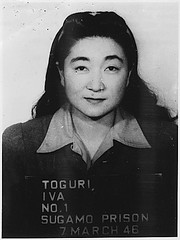
None of this meant much to Iva Ikuko Toguri D’Aquino, or as she would forever become known, Tokyo Rose. 

Iva was born in Los Angeles, she was a Girl Scout, a Methodist, and she had graduated from UCLA with a degree in zoology. In other words, Iva was an all-American girl. She left for Japan in July 1941, possibly to care for an ailing relative, or to attend medical school. 

Iva had been issued a Certificate of Identification, she didn’t have a passport.  In September 1941 she applied to the U.S. Vice Consul in Japan for a passport, but she’d not received an answer by the December 7, 1941 attack by the Japanese on Pearl Harbor. She was stranded in Japan for the duration.

Iva was pressured by the Japanese Central Government to renounce her U.S. citizenship; she refused. She risked her life to provide POWs with food.  By 1943 she, and prisoners of war, were coerced into producing radio broadcasts intended to demoralize the U.S. troops.  She participated, but would not speak against the United States – and at no time did she refer to herself as Tokyo Rose.  The name was a catch all used by U.S. troops to describe all of the women who made the propaganda broadcasts.

 Iva was arrested at the end of the war and thoroughly investigated by the FBI. The FBI concluded that:  “the evidence then known did not merit prosecution”.

Even so, in 1949 Iva was tried in San Francisco for treason.  She was found guilty on one count, that on a certain date in 1944 she “did speak into a microphone concerning the loss of ships.” She was fined $10,000 and given a 10-year prison sentence. Attorney Collins called the verdict “Guilty without evidence”.  She was sent to the Federal Reformatory for Women at Alderson, West Virginia. She was paroled after serving six years and two months, and released January 28, 1956.

 She was granted a full and unconditional Presidential pardon by Gerald Ford on January 19, 1977, his last full day in office.  She passed away on September 26, 2006; she was 90.

This is such a wonderful photo – it is of Raymond Chandler and Dorothy Fisher (nee Gruber).  Dorothy worked as his secretary at Paramount Studios in the 1940s. I was fortunate to have met Dorothy, she was an honored guest on a couple of Esotouric’s Chandler tours, and she was a remarkable woman.  Because we lived near each other we’d carpool to the departure location for the tour. We’d swap stories in the car on the way. She told me about a dinner date in Malibu with the actor Ray Milland, and she also told me about meeting Billy Wilder.  She said that Wilder was a powerfully magnetic man: “he made you feel like you were the only person in the room” she said.

Dorothy passed away in December 2008, and I will be forever grateful for the opportunity to have spent time in her company.  She was talented, intelligent, lovely, and a lady through and through. I think of her each time we visit Chandler’s Los Angeles.

So, if you’re a fan of noir, crime fiction, the Los Angeles Athletic Club and/or the best gelato in Los Angeles, this tour is for you! Because we stop at the historic Hollywood restaurant Musso & Frank, by the end of the tour I’m craving a gin gimlet something fierce. Lucky for me Scoops gelato generally offers a few liquor flavored choices (the vanilla/Jim Beam is delightful!)

I hope you’ll join us – especially since July is the month of Chandler’s birth.

I stepped out of the Vintage Powder Room for the month of June.  Why?  Well, I was establishing VPR on Facebook.  When I am doing resarch for the posts for this blog, I frequently find some terrific tidbits that don’t justify an in-depth post, but are simply too wonderful not to share. 

I’ve found that Facebook is perfect for the shorter posts, as is Twitter. So, if you have only a few moments to spare for the Vintage Powder Room and want to see some fabulous photos, videos, or items from my collection,  look for me on Twitter (vtgpowderroom), or on Facebook (search for Vintage Powder Room).  You’ll find links for both by scrolling down this page.

Now it’s time for me to roll up my sleeves and get back to work.


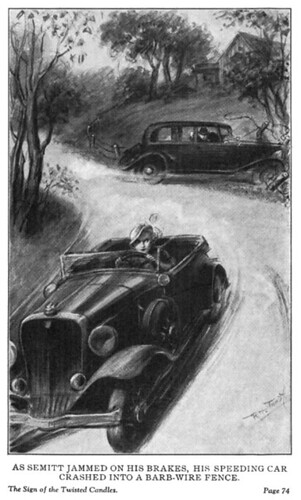
As soon as I saw the roadster (a  Duesenberg?)  in the illustration on the hair net package,  I knew that the  jaunty young lady at the wheel had to be the world renowned girl detective Nancy Drew.   

When you were a child did you ever want to be Nancy Drew?  I did.  And all these years later I’m still so captivated by the idea of being a gal gumshoe, a dame detective, a she shamus, that I give crime tours with the LA-based company Esotouric on most weekends.  But even the tours aren’t enough to satisfy my longing be a PI, cop, or a stylish and witty helpmate, like Myrna Loy in the Thin Man films.   

Just because I never became a private investigator or cop (I like to believe that I DID become a stylish and witty helpmate) that doesn’t mean that I can’t pursue my crime busting dreams.   I’ve discovered a few ways in which to get my crime  fix — the aforementioned tours, and I volunteer at the Los Angeles Police Historical Society (LAPHS).   

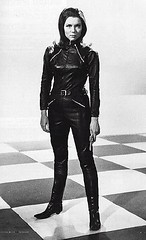
Diana Rigg as Mrs. Peel

The historical society has a fantastic museum which is housed in an old police station. I spend my time there organizing and digitizing a collection of Daily Bulletins, and Juvenile Reports.  The Bulletins began in 1907 and were distributed to each officer, every day (with the exception of Sundays and holidays). The Bulletins provide a daily snapshot of life in the growing city of Los Angeles, as reflected in the criminal behavior of its citizens. 

Nancy Drew did her sleuthing in River Heights, not in Los Angeles, and she began her amateur detecting as a 16 year old in 1930. The early books depict Nancy as a very modern girl — just as she should have been in the years following WWI.  She had a litany of accomplishments including: dancer, driver, cook, car mechanic, swimmer, seamstress, painter — and she was fluent in French!  If she’d had a leather cat suit, I’m sure she could have given Mrs. Emma Peel (of the  1960s series The Avengers) a run for her money.  

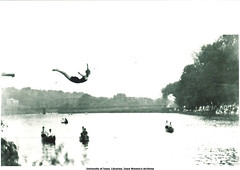
Mildred in mid-dive c. 1925

The woman who ghosted the Nancy Drew books for the Stratemeyer Syndicate from 1929 to 1953 was Iowan, Mildred Wirt Benson.  Mildred was nearly as accomplished as Nancy. At the University of Iowa she participated in swimming, soccer, and was a student journalist.  Following graduation  she worked as a general reporter for the The Clinton (Iowa) Herald.  

Mildred was only 21 when, in 1926, she answered an ad placed by the Stratemeyer Syndicate for ghost writers. Her first assignment resulted in the novel, Ruth Fielding and Her Great Scenario.   

Mildred appears to have remained as feisty as Nancy Drew ever was, because she began to take flying lessons at age 59.  I’m glad to report that Mildred lived a long life – she passed away in 2002 at the age of 96.  

Nancy Drew has gone on to have a long and eventful life too. There were some terrific films in the 1940s featuring Bonita Granville as Nancy, and more recently (2007) Emma Roberts played the girl sleuth. In 2002 the first Nancy Drew book, The Mystery of the Old Clock, sold over 150,000 copies!


 Oh, and if you think that Nancy Drew was a pre-feminist bimbo who couldn’t possibly have had an impact on intelligent and strong women, think again. Secretary of State, Hillary Rodham Clinton cites her as an early influence, and so do Supreme Court Justices Sandra Day O’Connor, Ruth Bader Ginsberg, and Sonia Sotomayor.  

For more information on Mildred Wirt Benson visit the University of Iowa Digital Library.

« Previous PageNext Page »