« Previous PageNext Page »

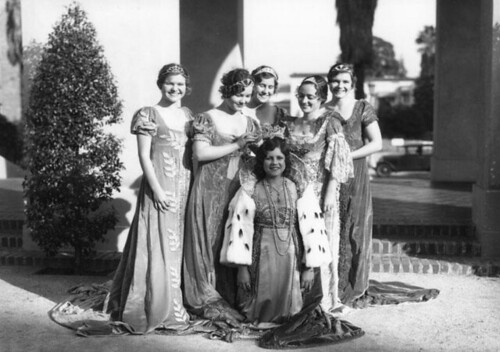
Rose Queen and her Court, 1931

Rose Queen and her Court, 1931

 The lovely ladies are: Mary Lou Waddell (kneeling); left to right: Myrna Wilson, Alice Ashley, Fannie Arnold, Myrta Olmstead, Florence Dunkerley.

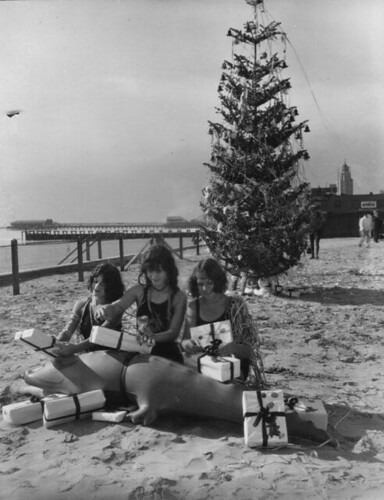
Warm wishes for the holiday season

Warm wishes for the holiday season


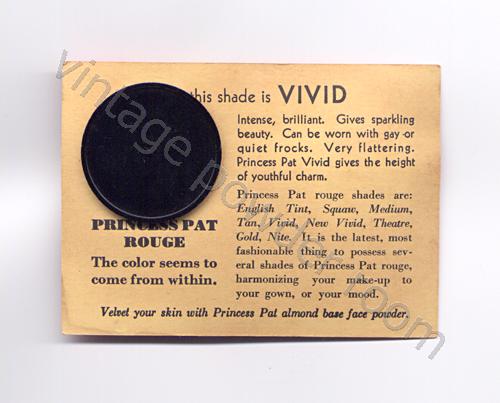
The celebrity endorsement of cosmetics is nothing new. The Princess Pat rouge card featuring a photo of the lovely actress Loretta Young is a fine example of an early relationship between a cosmetics company and a Hollywood star.

Princess Pat used many Hollywood actresses to endorse their products, and I’ll be highlighting some of them in future posts.

The rouge card on which Loretta Young appears dates from the late 1920s to early 1930s when she had begun to establish herself as a  major star.  Loretta was born Gretchen Young in Salt Lake City, Utah on January 6, 1913. Her parents Earl Young and Gladys Royal had married impulsively as teenagers in 1908. Early in their marriage Gladys suspected that Earl was being unfaithful; so after several years of strife, and four kids, the couple separated and Loretta’s mom moved the family to Southern California where she ran a boarding house.

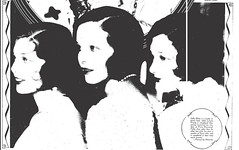
The Young Sisters

The Young Sisters

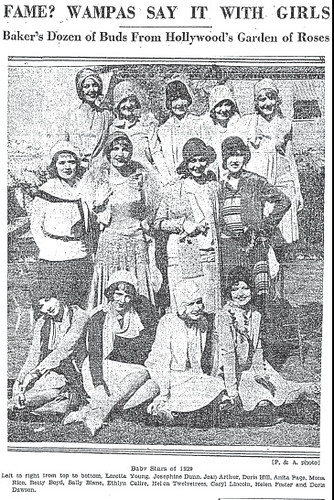
Baby Stars of 1929

Baby Stars of 1929

Shortly after their move to Los Angeles Loretta’s older sisters Polly Ann and Betty Jane began to appear in silent films, and Loretta would soon follow. 

Loretta’s first (uncredited) movie role was that of a fairy in the 1917 film “The Primose Ring”. In 1929 Loretta, as well as her sister Betty Jane (who was using the name Betty Blane), were pegged as two of the thirteen girls selected by members of the Western Moton Picture Advertisers (WAMPAS) to be baby stars.  WAMPAS had been naming girls for the honor since 1922, and from their ranks rose some of Hollywood’s biggest names. Mary AstorJoan Crawford, and Fay Wray were three of the thirteen picked in 1926! Quite a stellar line-up.

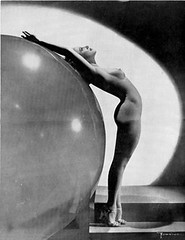
One of my favorites of the WAMPAS baby stars was Sally Rand. Rand was chosen in 1927, and by the 1933 Chicago World’s Fair  she was working steadily in burlesque. Sally was famous for her fan dance, and for the bubble dance, which she is credited with developing.

Sally Rand

Sally Rand

The annual WAMPAS Frolic, the event at which the thirteen young Hollywood hopefuls were feted, came to an end in 1934. The reason for its demise was primarily due to the studios creating their own awards for up and coming starlets — stealing thunder from WAMPAS and diluting what had once been a more exclusive honor.

Loretta would have succeeded even if she’d never been chosen by WAMPAS. She was beautiful, with amazing cheekbones, and she was also a very talented actress (she won an Oscar in 1947 for her performance in “The Farmer’s Daughter“). She starred opposite Spencer Tracy in his first Hollywood leading role in the 1933 film “Man’s Castle”.  Spencer was married and 13 years her senior, but that wouldn’t have made him any less attractive to 20 year old Loretta. He was a charmer and he was Catholic. That she and Spencer shared a faith would have been important to her — of course it would also be one of the many reasons why the two couldn’t pursue a permanent relationship, and Loretta said as much in a 1934 public statement.

Loretta and Clark

Loretta and Clark

In 1935 Loretta was working opposite the “King of Hollywood”, Clark Gable, in “Call of the Wild”. Loretta may have been seeking love and romance, but the married Clark was probably looking for a diversion from his marriage. The two had an affair and Loretta became pregnant. During her last trimester she and her mother went to Europe, and it was there that she gave birth to a daughter, Judy. That the child was Gable’s was not the best kept secret in Hollywood, but times were different then and Loretta was never directly confronted by the press.

Having a child out of wedlock in the 1930s, public figure or not, was a difficult situation.  Further complicating matters for Loretta would have been her ambitions for her acting career and her religious beliefs. Her solution was to place Judy in a foundling home for about a year until she could formally adopt her!  Judy’s true parentage remained an open secret, but she didn’t get the details first hand from her mother. She was 23 years old and about to be married when she heard the story from her fiancee for the first time. She had told him that she couldn’t marry him because: “I don’t know who I am.” He told her that he knew everything about her, and that she was Clark Gable’s daughter with Loretta.

On the advice of a priest she didn’t confront her mother about it at the time. She would wait for nearly ten years until she finally approached her mother and started to ask questions. Loretta came clean, but asked Judy to keep the secret — which she did. Loretta would not publicly confirm the story until she wrote her autobiography, and even then she asked that the book be published posthumously.

Loretta passed away in Palm Springs on August 16, 2000.

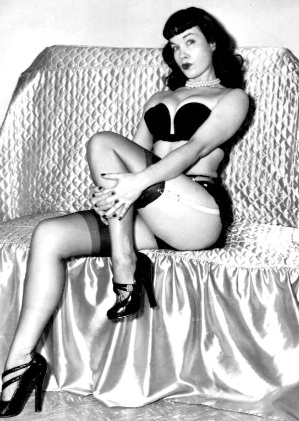
Betty Page

Betty Page


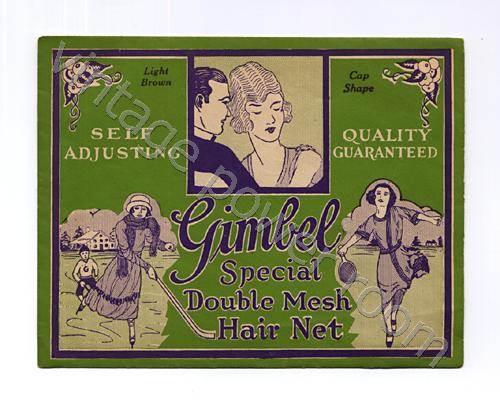
The Gimbel hair net envelope dates from the early to mid 1920s. The sweet little floral design in the upper corners is typical of the period, and the depiction of women playing sports reflects the sports mania that was a large part of the era.

I have an admission to make — I did not give up a promising career in sports to become a writer. Things may have been different for me if I’d been around in the 1920s because sports of all kinds were wildly popular. In particular, women enthusiastically participated in everything from tennis to hockey. Maybe I’d have found my sport and excelled in it, just like Suzanne Lenglen did.

Suzanne Rachel Flore Lenglen was born on May 24, 1899 about 70 km north of Paris, France, and she would become the first female superstar in tennis, and also the first major tennis star to turn professional.  Suzanne was a sickly child who suffered from several ailments, including chronic asthma, so her father suggested that she try tennis as a way to build her strength. Almost immediately she demonstrated a talent for the sport and her father began to train her in earnest. He would place handkerchiefs around the court which he would then expect Suzanne to be able to hit with a serve or return. Young Suzanne was an apt pupil and she quickly became a player to be reckoned with.

In 1914, only four years after beginning to play, Suzanne spent her 15th birthday winning the World Hard Court Championship at Saint-Cloud.  The outbreak of World War I at the end of 1914 put an end to  most national and international tennis competitions, and Lenglen would have to wait until 1920 to begin to compete on the world stage.
King George and Queen Mary

King George and Queen Mary

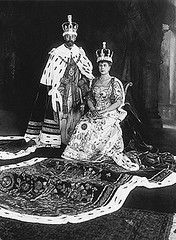
At Wimbledon in 1920 the young French woman faced Dorthea Douglass Chambers. Chambers had won at Wimbledon seven times previously, and Suzanne had never before played on a grass court! The women played to a packed stadium of several thousand spectators, including King George V and Queen Mary!
Charlotte Cooper

Charlotte Cooper

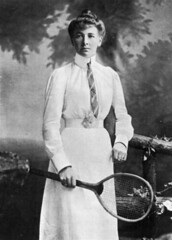
Sure, it was a stellar match — which Suzanne went on to win, but what really captured the attention of the  crowd was the audacity of Lenglen’s tennis costume, and maybe the fact that she would sip brandy from a flask between sets. In the years prior to 1920 women had played tennis dressed similarly to Charlotte Cooper, and probably sans a booze filled flask.

Suzanne was a rebel. She would play tennis in a dress that fell only to mid-calf (revealing the tops of her stockings when she moved just so); and if that wasn’t shocking enough, she bared her forearms, wore a nifty little bandeau, often secured with a brooch, on her cropped ‘do and she frequently appeared on the court in make-up.  She was given the nickname La Divine and it suited her. She was a sports diva. She was passionate and wasn’t shy about showing her emotions. She would often pout or burst into tears if she played badly.

Suzanne Lenglen

Suzanne Lenglen

Imagine for a moment being dressed like Charlotte Cooper and then attempting to compete with Suzanne as she darted around the court unencumbered by a voluminous skirt, long sleeves, starched collar and tie!
Jean Patou

Jean Patou

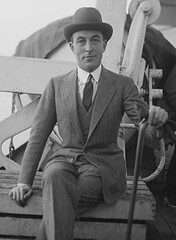
Suzanne’s daring costume  revolutionized the way in which women dressed to play tennis, and in addition to her cutting edge tennis togs(designed by the legendary couturier Jean Patou!), Suzanne made a fashion statement off of the court with her bobbed hair, make-up, and clothing in the latest styles. She was admired for her skill with a tennis racket, and for her fashion sense. In fact, Miss Lenglen even had a tennis shoe named after her!
Suzanne at Wimbledon, 1926

Suzanne at Wimbledon, 1926

So, let’s raise a flask of brandy (or in my case a gin gimlet) and make a toast to the incomparable Suzanne Lenglen. What a remarkable woman. She won at both Wimbledon and the French Open setting records that would remain unbroken for decades.

Suzanne would retire from the world of tennis and go on to found a school where she would teach others to play and to love the game. Among her accomplishments she was an author who wrote Lawn Tennis (1925), Lawn Tennis for Girls (1930), and Tennis by Simple Exercises (1937).
Tragically, her life would be cut short. She was diagnosed with leukemia in June of 1938. Three weeks following a newspaper report of her ailment she went blind. She died at age 39 on July 4, 1938 of pernicious anemia.

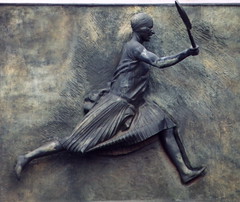
Suzanne’s legacy lives on — Court Suzanne Lenglen is the secondary tennis court at the Stade Roland Garros in Paris, France. It was built in 1994 and holds 10,068 spectators. There is a statue of Suzanne, in full stride, outside of the stadium.
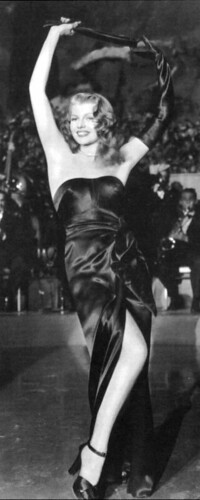
Rita Hayworth in Gilda

Rita Hayworth in "Gilda"

So many noir events in November — where do we begin?

Esotouric kicked off the month with the Real Black Dahlia tour on November 1st. What’s next on the agenda?  How about The Birth of Noir: James M. Cain’s Southern California Nightmare on Saturday, November 8, 2008? Among the sites we’ll visit: Mildred Pierce’s home, Forest Lawn Memorial Park, and the Glendale Train Station.

We’re inviting everyone to dress in their favorite 1940s attire. So ladies, channel your inner Joan Crawford and slip into something with wicked huge shoulder pads. And gentlemen, this is an opportunity to become your favorite noir tough guy, so don a trenchcoat and a battered fedora (but leave your snub-nosed .38 at home, please). The tour departs from Phillippe’s The Original — be sure to order a slice of pie, won’t you? 

The Los Angeles Conservancy (for which I volunteer as a docent) is hosting a one day Noir-chitecture event on Sunday, November 9, 2008.  I’ve heard that it is sold out, so I hope that you have signed up! Each site on the self-guided tour is a gem and all have a connection to noir literature and/or film. You’ll find me at the Glendale Train Station (twice in two days — I love it!) from 12:45 to 4:00 on tour day.  The lovely old station was built in the 1920s and served as a location in the classic film noir, Double Indemnity.

I killed him for money and for a woman. I didn’t get the money… and I didn’t get the woman Walter Neff in Double Indemnity

"From the Moment they met it was Murder!"

Check out Barbara Stanwyck (left). Isn’t she the epitome of 1940s style? Her classic pageboy ‘do (which was a wig), red lipstick (doesn’t it just HAVE to be red?!) and her sunglasses! Absolutely wonderful. You can’t see it in the photograph, but Barbara wears an anklet in the film. Delicate and lovely, the chain will come to symbolize the noose which will grow tighter and tighter around the necks of the murderous lovers.

Double Indemnity, written by James M. Cain, was inspired by an infamous murder case. On March 20, 1927, housewife Ruth Snyder of Queens, New York and Nelson Gray, a corset salesman, garroted Ruth’s husband Albert, stuffed his nose with choloformed rags, then staged the scene as a burglarly gone wrong.  Snyder and Gray murdered Albert so that they could collect a nice fat insurance policy and live happily ever after.  

The couple turned out to be hopelessly inept at crime and was quickly busted for the murder. They were subsequently convicted and both were sentenced to death by electrocution.  

The crime had nothing to distinguish it — lust and greed are hardly unique motives for murder; and the case would likely have faded into obscurity if not for the efforts of innovative newspaper photographer Thomas Howard of the New York Daily News. He was a witness to Ruth’s execution and he was determined to get a scoop.

The wiley shutterbug strapped a miniature camera to his leg, and at the moment that “state electrician” Robert C. Elliott flipped the fatal switch Howard captured Ruth’s death throes for posterity.

Welcome to the dawn of modern tabloid journalism.


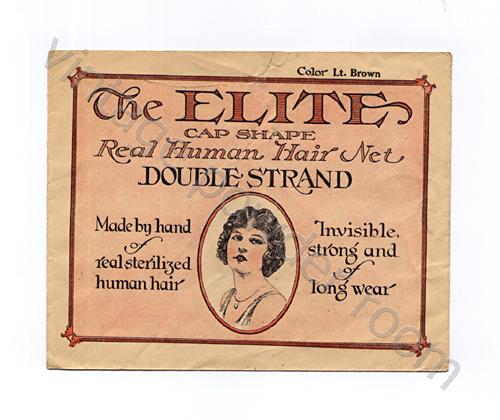
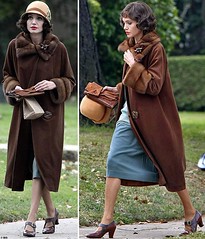
Because of my interest in Los Angeles history, crime, vintage clothing, and cosmetics history, I rushed out to see The Changeling last weekend. As a result, I decided to feature the Elite hair net package from my collection. The woman  on the envelope is from the same era (c. 1928) as depicted in the film, and the hairstyle resembles that worn by Angelina Jolie who stars in the movie.
  
The story that inspired the The Changeling is even more compelling and repellent than the story told by the film. Compelling because it is based upon an actual case from Los Angeles in the 1920s. Repellent because of the nature of the crimes (the kidnapping, molestation, and murder of young boys), and also because of the criminal — a sociopath by the name of Gordon Stewart Northcott. (Warning — spoilers for the film to follow.)
Walter Collins

Walter Collins

 
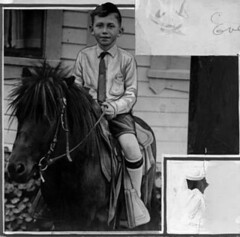
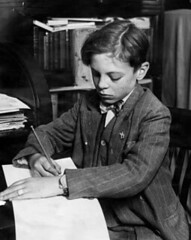
On March 10, 1928 Walter Collins, aged nine, vanished from his home at 217 North Avenue 23 in Lincoln Heights, CA. By August, Los Angeles police claimed to have located Walter in De Kalb, Illinois. The boy was returned to Los Angeles, but as soon Christine Collins, Walter’s mom, clapped eyes on the boy she knew that he was an imposter.
 
Corruption was rife in Los Angeles at the time and some members of the LAPD, as well as local politicians, were involved in bootlegging, gambling, and prostitution. The police department couldn’t bear further scrutiny or negative press, and they were anxious to have a public relations win. Returning the Collins boy to his mother was just what they needed. The difficulty that they couldn’t overcome was that the boy that they brought back to Los Angeles to be reunited with Christine was not Walter!
Arthur Hutchins, Jr.

Arthur Hutchins, Jr.

Christine resisted, but was finally convinced by LAPD Captain J.J. Jones to take the boy home with her. No amount of wishing, or coercion by Jones, would make the faux Walter morph into the genuine article. Christine kicked up a fuss and was summarily committed by Captain Jones to a local psych ward. It took about 10 days to pry the truth out of the devious counterfeit Walter.

After giving authorities at least two more aliases, the boy finally admitted that he was Arthur Hutchins, Jr. from Marion, Iowa and that he’d pretended to be Walter Collins to get a free trip to Los Angeles. It seems that young Arthur was a big fan of cowboy films — particularly Tom Mix.
 
Meanwhile, out in Wineville, CA (now Mira Loma) the depraved and profoundly evil Gordon Northcott was molesting, torturing and murdering young boys. One of whom was probably Walter Collins.
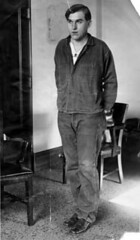
Gordon Stewart Northcott

Gordon Stewart Northcott

 
Then in a deus ex machina worthy of a Greek tragedy, a Canadian cousin of Northcott’s, Sanford Clark (aged 15) entered the drama. He’d been gone from his home for two years when he was arrested at the Wineville ranch as an illegal alien and held for deportation.  While in custody the young man broke down and told police a story so heinous that it was difficult for them to believe him. He said that Gordon Northcott had forced him to assist in the kidnapping and murder of several young boys.
 
Murder chicken coop

Murder chicken coop

Even as newspaper headlines screamed “Murder Farm” from the newsstands, Gordon and his mother fled to Canada to avoid prosecution. They could run, but they couldn’t escape the long arm of the law. The two were soon located and returned to California to stand trial.

 
In a noir twist echoed decades later in the Roman Polanski film Chinatown (“she’s my sister, she’s my daughter”) during his trial Gordon would learn that his mother was in fact his grandmother, and that he was the result of an incestuous relationship between his sister and his father.
 
Gordon was found guilty and sentenced to death by hanging. His mother/grandmother (who had initially confessed to killing Walter Collins, then recanted) was sentenced to life in prison, but she was paroled after serving only 12 years.
 
I loved being able to identify some of the buildings used in the film, and found the interior sets to be  faithful to the era. 
Angelina Jolie as Christine Collins

Angelina Jolie as Christine Collins

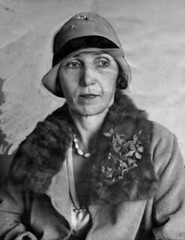
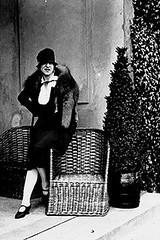
Angelina Jolie’s wardrobe in the film was gorgeous, and the credit goes to costume designer Deborah Hopper who has worked with director Clint Eastwood for over 20 years. According to Wikipedia, Hopper had to find 1920s style clothing for approximately 1000 people! Archive media featuring the real Christine Collins was used to create Angelina’s authentically styled wardrobe (note the cloche hat and the coat with the fur collar).  Jolie’s makeup was also correct for the time; but as you can see in the photo the real Christine wore few, if any, cosmetics.

One thing I noticed was that Angelina’s shoes are almost certainly reproductions made by an LA-based company called Remix Vintage Shoes.  Check out their site and see if you agree.
Christine Collins

Christine Collins

 
In the film, as in life, Christine Collins never stopped believing that Walter was alive. She pinned her hopes in part on Northcott’s cynical and cruel manipulations.  From death row he continued to taunt and torment the parents of the victims by sometimes accepting responsility for the killings, and then later insisting that he’d had nothing to do with the slaughter at the ranch. Remains found at the chicken ranch in Wineville could not be positively identified as Walter’s, and this too kept Christine’s hope alive. Her dream of a reunion with her son must have been rekindled when a boy believed to have been murdered by Northcott turned up several years later alive and well.
 
Sadly, Christine never saw Walter again in this life and she eventually disappeared from public view. The last mention of her that I could find was on January 21, 1941 in the Los Angeles Times.  The newspaper reported that she had renewed a suit for damages against Captain J.J. Jones, the cop who’d had her committed to the psych ward when she refused to accept Arthur Hutchins, Jr. as her son.
 

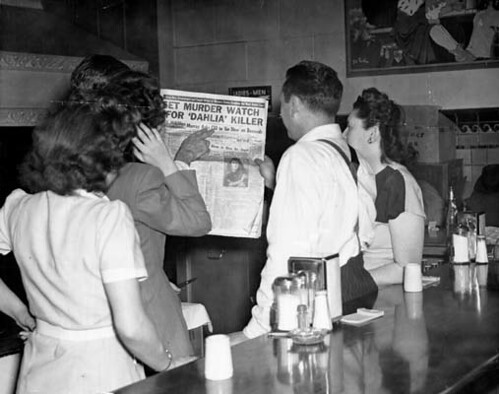
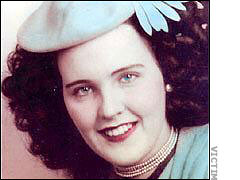
On January 15, 1947 the body of a young woman was discovered in a vacant lot in a suburb of Los Angeles. She would later be identified as Elizabeth Short, and dubbed the Black Dahlia.

Over the decades many people have attempted to solve the crime. Steve Hodel in his book [Black Dahlia Avenger] arrived at the conclusion that his own father was the killer! And he’s not alone. Janice Knowlton wrote a book [Daddy Was The Black Dahlia Killer] accusing HER father of the murder.  Neither book is credible. The crime has been depicted in fiction too, most notably in James Ellroy’s neo-noir novel The Black Dahlia.

So much attention has been focused on trying to solve the mystery of her killer, that surprisingly little effort has gone into unraveling the enigma of Beth herself.

Max Factor ad c. 1947

Max Factor ad c. 1947

One of the ways in which to unmask the real Elizabeth Short — who she was, and who she wanted to be — is to deconstruct the face she presented to the world.

Murder and pancake makeup. What’s the connection? 

Join us on the Esotouric crime bus on Saturday, November 1, 2008  and find out. 

I dare you.


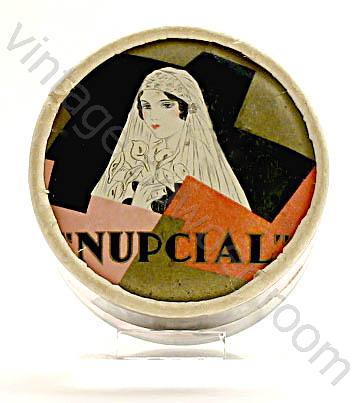
Here comes the bride, all dressed in white – and surrounded by art deco geometry. The bride on the Nupcial face powder box is dressed for a wedding in the late 1920s or early 1930s. She’s wearing a cloche style headdress, her hair is bobbed, and her bee-stung lips are painted a vivid crimson.

She represents a typical bride of the time, and she is obviously wearing make-up.  Commercial cosmetics were a recent phenomenon in the 1920s and 30s. Prior to that time women had passed recipes for kitchen cosmetics and skin preparations to one another. The recipes were often contained in cookbooks which were given as gifts, or handed down from mother to daughter. When the Nupcial bride was walking down the aisle, whether or not to “paint and powder” was still the subject of contentious debate.

The bride in the photo looks radiant and deliriously happy, or maybe just delirious; but what about the darker side of brides? For the noir side of brides we need only to look at the 1935 film, “Bride of Frankenstein”.  Elsa Lanchester may have been one of the most reluctant brides ever. She took one look at her intended mate, Boris Karloff, and let out an ear piercing shriek of terror.  Not exactly an “I do”.
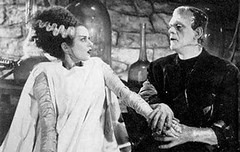
Bride of Frankenstein

Bride of Frankenstein

I always feel sorry for the monster – look at his face, he was obviously smitten, and you can see why, Elsa made a lovely bride – even with the lightening bolt of white in her hair, and the extensive scarring on her neck.

“For her fifth wedding, the bride wore black and carried a scotch and soda.”

Phyllis Battelle, journalist

They may look benign in their beautiful gowns; with their hair perfectly coiffed and their makeup flawlessly applied, but brides can also be serial killers! The bride in Cornell Woolrich’s novel was widowed on her wedding day. She was not about to let the murderers escape justice, and the novel tracks the homicidal nearlywed as she lures, ensnares, then bumps off the five men who ruined her life. What the homicidal bride doesn’t know about the death of her groom is revealed in a contrived twist at the novel’s end.
Although he was not the same caliber of writer as either Raymond Chandler or Dashiell Hammett, Cornell Woolrich was one of the fathers of the 20th century crime novel. He penned the story Rear Window which became the great Alfred Hitchcock film of the same name.

 Woolrich was a profoundly unhappy man. He was a self-hating homosexual and was a groom one time only. He may have been even more hesitant to walk down the aisle than Frankenstein’s intended.  On a whim, he married the daughter of a movie mogul. The marriage was not consummated, and after a desperate phone call from his mother who claimed that she couldn’t live without him, he moved in with her and never left again.

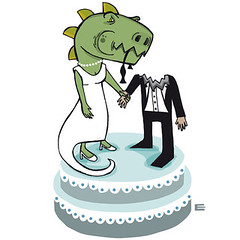
Even in these enlightened times, wearing white and walking down the aisle with the man of your dreams seems to be a national obsession. There are TV shows devoted to brides behaving almost as badly as the woman in Woolrich’s novel. These women are the notorious “Bridezillas”.  Nothing makes them happy – neither the dress, nor the catering, and perhaps not even the groom. They roar and stomp, and generally make life miserable for all those with whom they come in contact. I’d rather face a starving raptor.

I think that the preoccupation with over the top weddings is a component of the nation’s other reigning mania – the desire for fame.  It seems as if everyone wants to star in her or his own movie, or share space with a “celebutante” on the cover of a supermarket tabloid.

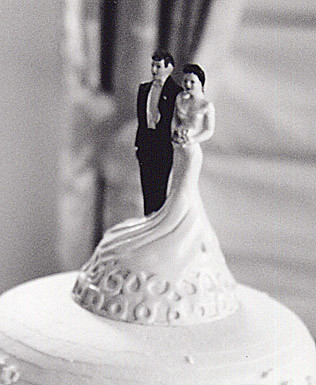
My groom and I opted for a small retro style wedding. The elegant vintage cake topper was a flea market find and suited the theme of my wedding perfectly. I will always cherish it.

The streets were dark with something more than night.
Raymond Chandler

Deadly dames, snub nosed revolvers and gin gimlets — have I died and gone to noir heaven? No!  I’ve just climbed aboard the Esotouric bus for In A Lonely Place: Raymond Chandler’s Los Angeles.  Please join us this Saturday, October 11, 2008 as we explore the mean streets of Chandler’s LA. It’s also a swell chance to visit the venerable Vroman’s Bookstore in Pasadena (the tour will depart from there).

Details at Esotouric.

« Previous PageNext Page »